
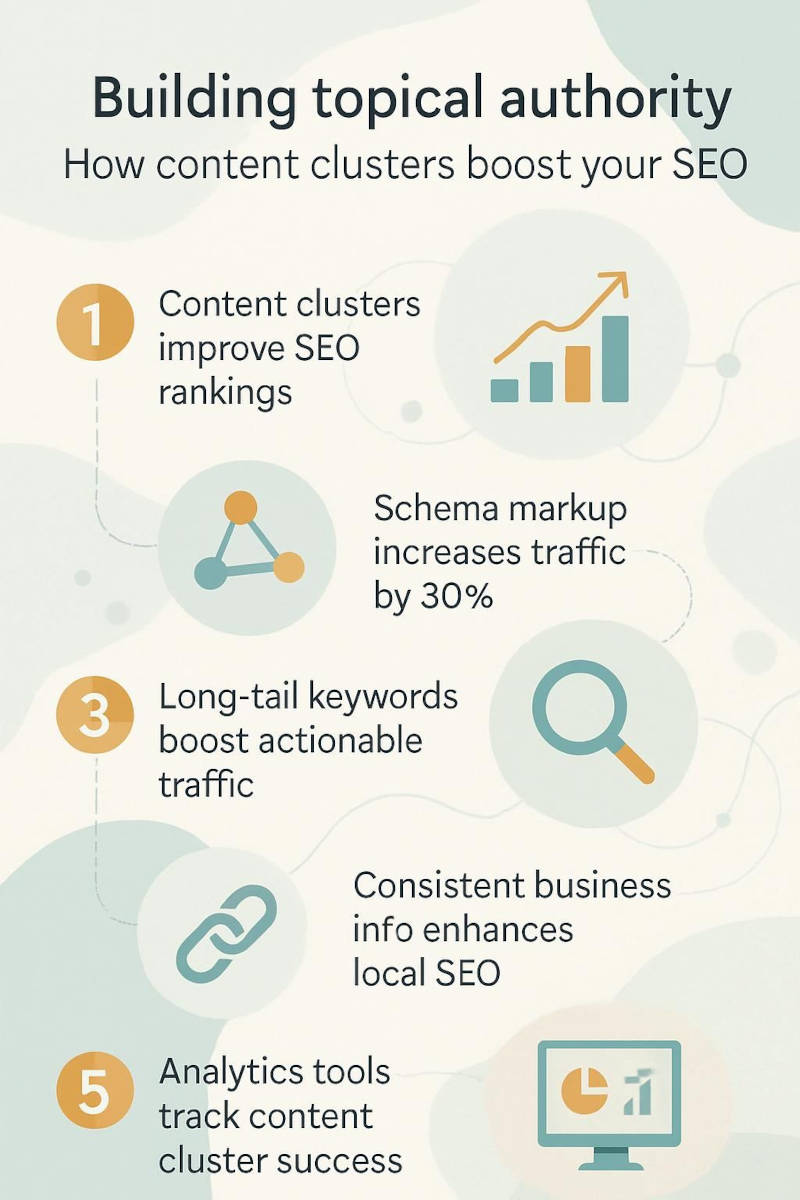
Building topical authority: How content clusters boost your SEO
You’ve worked hard on your website, but Google still won’t rank you high. The truth is harsh. Most people click only the top few search results. This guide shows you how to build topical authority with smart content clusters. You’ll learn proven methods to climb those search engine rankings and get more organic traffic.
Ready to transform your SEO game?
Key Takeaways
- Content clusters help websites rank higher by showing Google you’re an expert. They also make it easier for search bots to understand your content.
- Schema markup can boost organic traffic by up to 30% (Search Engine Journal). It turns regular results into rich snippets with stars, ratings, or quick answers.
- Target long-tail keywords like “simple topic cluster strategy for dog training blogs.” These specific phrases attract users ready to take action. Voice searches make them even more valuable today.
- Fill out every detail in your Google Business Profile. Add quality photos. Keep your business info the same across all platforms. This improves local SEO and brings more customers to your door.
- Track your success with the right metrics. Watch organic traffic, click-through rates, and People Also Ask coverage. Tools like Google Analytics, SEMrush, and Ahrefs show what’s working for each content cluster.
Understanding Zero-Click Searches and AI-Generated Answers
Google often shows answers right on the results page now. You type a question and get your answer instantly. No clicking needed. These are zero-click searches. You’ll see maps for local bakeries, snippets with quick facts, or sports scores in neat Google boxes. Users get what they want fast. Only some people click through to websites anymore.
AI-generated responses are changing how people search online too. Tools like Bing Chat or Gemini pull data from many sources. They create clear answers that appear above regular search results. Your content needs to match what people are actually searching for. Use topic clusters and strong SEO strategies. This helps your content appear in those prime spots instead of getting buried.
Optimize for Featured Snippets and Knowledge Panels
Featured Snippets and Knowledge Panels put your content at the top of search results. These tools provide quick answers and increase your online visibility.
- Write clear, direct answers to common questions in your topic cluster pages. Featured snippets often pull from simple, easy-to-read content.
- Use headers like H2 or H3 to break up sections. This helps crawlers find useful info quickly for SERP features.
- Add statistics, numbers, or facts in bullet points or short paragraphs. These work great for answer boxes and pull quotes.
- Structure each post with a simple format. Try question-answer or problem-solution layouts. This makes it easier for algorithms to spot key details.
- Link related posts within your site with descriptive anchor text. This shows search engines your expertise across different topics.
- Organize data tables and lists clearly. Machines pick up structured information faster for display in panels or boxes.
- Complete all detailed entity information on Google Business Profile. This feeds knowledge graphs that power rich results.
- Add schema markup like FAQPage, HowTo, Person, Organization, or Product to your pages. This gives context clues about your authority.
- Update older articles with new facts or fresh data. Timely updates increase your chances of getting featured spots in search results.
- Target long-tail keywords that match how real people search. AI systems prefer natural language questions for snippet selection.
Ready to take your SEO further? Let’s explore schema markup and structured data next.

Leverage Schema Markup and Structured Data
Search engines need structure to understand your content. Schema markup helps Google and Bing make sense of your content clusters. It boosts your authority in search results. Think of schema as a label for your online content. It tells search bots if your page is a recipe, FAQ, product review, or business listing.
Tools like Google’s Structured Data Markup Helper can boost your click-through rates fast. Search Engine Journal reports that sites using structured data see up to 30% higher organic traffic. Rich snippets pop out on the SERP with rating stars or quick answers. They draw more eyes and earn stronger trust without extra words.
“If you want the spotlight on Google’s stage,” says John Mueller from Google Search Relations Team, “use schema.” Your content gets noticed when you add this simple code to your pages.
Focus on People Also Ask (PAA) Boxes
People Also Ask (PAA) boxes show up on Google’s search results page. They display related questions users want answered. Creating clusters of connected content helps your answers land in these PAA spots. This boosts your online visibility and builds authority. Structure your articles with clean headers and clear answers that match real search intent.
Use keyword research tools like Answer the Public or SEMrush. These help you find popular questions about your main topic cluster. Keep each answer short. Google loves concise responses for quick display in knowledge panels or snippet boxes. Add relevant keywords naturally. Write like you’re talking with a curious friend over coffee, not reading from a dictionary. Target these question clusters consistently. You’ll see better SERP click-throughs and steady organic traffic growth.

Create High-Value Visual and Interactive Content
Now that you’ve tackled PAA boxes, it’s time to grab attention with visuals and interactive elements. Google favors content that offers more than just keywords. It wants real value. Tools like Canva and Adobe Express make adding images simple. Even if graphic design isn’t your thing. Readers stay longer when they can explore infographics or charts about your topic clusters.
Interactive features can boost engagement and bring organic traffic through your door. Try adding quizzes, polls, clickable timelines, or simple calculators. Clear diagrams help explain tough SEO concepts without making people’s heads spin. Videos from platforms like YouTube break up walls of text. They support authority building for niche marketing at the same time. Mix photos, charts, or graphs into posts about information architecture. This keeps things interesting. Nobody wants to stare at blocks of words all day!
Build Topical Authority and Knowledge Graphs
Google wants depth, not surface-level content. Picture your website as a library. Each topic cluster works like a bookshelf full of related books. You connect them through smart internal links and strong headers. Google’s Knowledge Graph helps search engines connect your pages, keywords, and ideas. This gives you better chances of ranking high in search results.
Wikidata and schema markup add power to this approach. They show search engines and users that your site has accurate info on every part of a subject. Smart use of structured data builds trust and credibility. It also boosts organic traffic. Follow Wikipedia’s example. Link to trusted sources often. Make each page answer one clear question or need within its cluster. This keeps your information architecture organized and clean.
Optimize for Long-Tail Keywords and Natural Language
Long-tail keywords attract people searching for specific answers, not just buzzwords. Someone might type “simple topic cluster strategy for dog training blogs” instead of just “SEO optimization.” These longer phrases work like fishing nets. They catch more targeted visitors who are ready to read or buy. Voice searches add another layer. People ask questions in plain English now. They chat with their phones like old friends. Your content needs that same natural flow.
Tools like SEMrush and Answer The Public help you find those real-life questions hiding below the surface. Add these longer phrases to your headings and body text. Keep it natural though. This maintains clean information architecture while building topical authority on every niche subject you cover. Search engines love feeding this content into People Also Ask (PAA) boxes. That’s exactly where we’re heading next.

Enhance Your Google Business Profile and Local Listings
Local SEO can transform small and medium businesses. Your Google Business Profile acts as your digital storefront. Polish it up to improve online visibility.
- Fill out every field in your Google Business Profile. Include hours and address. Customers get all the info they need fast.
- Add high-quality photos of your products, staff, or location. Clear photos catch eyes and tell your business story.
- Ask happy customers for reviews using Google’s review tool link. Positive reviews influence local search rankings.
- Reply to all reviews, good and bad. This shows you care about feedback. A simple “thank you” goes far with locals and search engines.
- Update posts regularly with new deals or services. This makes them pop up on Maps and Search results. It signals an active business.
- Use relevant keywords in your business description. Keep it natural though. Try phrases like “organic coffee shop in Dallas” for better ranking.
- Pick the right categories for your business. Google connects you to people who already want what you offer.
- Share important updates like holiday hours or safety measures. Timely info builds trust and keeps people coming back.
- Check your profile insights weekly through Google’s dashboard. Learn what brings visitors in. Adjust as needed.
- List your business on Bing Places, Apple Maps Connect, Yelp, Foursquare, TripAdvisor, and Yellow Pages Online. This gives you more reach beyond just Google searches.
- Make sure name, address, and phone number match everywhere online. Consistency helps boost authority building across directories.
- Encourage check-ins or photo uploads by loyal customers. These keep profiles fresh. They add keyword-rich user content that search engines love.
These steps boost SERP rankings and bring more foot traffic through your door. You’ll see results faster than you can say “content strategy.”

Diversify Traffic Sources Beyond Organic Search
Social traffic isn’t just a nice extra. It fuels your authority building and keeps you flexible. Paid ads, email newsletters, podcasts, and forums like Reddit give your content clusters more reach. Strong topic clusters can shine on YouTube or LinkedIn. They draw in people who might never use a search engine first.
Content marketing shouldn’t live in one place. Create video content for Instagram Reels. Design infographics for Pinterest. Host webinars that drive traffic back through shared links. Smart use of these SEO optimization tools increases your online visibility beyond the usual SERP crowd. Real brand mentions and viral posts can send site visits soaring. Even on days when Google gets stingy with organic clicks.
Invest in Brand Mentions and Off-Site Visibility
Google watches brand mentions closely. When your name appears on trusted news sites like Forbes or industry blogs, you earn trust with search engines. Even without a link back to you. More chatter about your brand across the web boosts authority building. It signals credibility to both visitors and bots.
Think beyond backlinks for SEO optimization. Try press releases and guest posts in relevant online magazines. Build social proof on review platforms like G2. Do interviews or podcasts. These efforts lift your topic clusters into new corners of the internet. With more eyes on your brand through these methods, you’ll have a stronger shot at higher SERP rankings. You’ll also see steady organic traffic growth that supports your core content strategy.

Measure Success Through Analytics and Key Performance Indicators
Tracking your SEO wins feels like checking the scoreboard at halftime. Here’s how to measure what’s working and what needs improvement. From content clusters to conversion rates.

| Metric | What It Shows | Tools | Tips & Insights |
|---|---|---|---|
| Organic Traffic | Visits from search engines | Google Analytics, Matomo |
|
| Keyword Rankings | Position for target phrases | SEMrush, Ahrefs, SERPWatcher |
|
| Click-Through Rate (CTR) | Percentage of searches clicking your result | Google Search Console |
|
| Pages per Session | Average internal pageviews per visit | Google Analytics, Plausible |
|
| Average Position | Mean ranking across tracked terms | Search Console, Moz Pro |
|
| Backlinks | Sites linking to you | Ahrefs, Majestic, Moz |
|
| Conversion Rate | Percent of visitors taking an action | Google Analytics, Hotjar |
|
| Engagement Metrics | Time on page, scroll depth, shares | Hotjar, Google Analytics |
|
| People Also Ask Coverage | Placement in Google’s “People Also Ask” | SEMrush, Moz Pro |
|
| Knowledge Panel Visibility | Appearance in branded knowledge panels | Search Console, BrandYourself |
|

Conclusion
Building topical authority with content clusters isn’t rocket science. But it packs a punch for your SEO. Connect your best ideas with solid internal linking and clear information architecture. You’ll boost online visibility faster than you think. Search engines love organized topic clusters. So do readers looking for depth.
Get serious about keyword research. Keep refining your content strategy. Watch those search engine rankings climb like a squirrel up a tree. Real value brings that organic traffic straight to your digital doorstep.