Discover Entity SEO Secrets for Superior Search Rankings!
Are you struggling to get your website noticed by search engines, even with solid content and good keywords? Entity SEO represents a more straightforward approach than many business owners realize, and it delivers real results for the right types of websites.
This guide will show you exactly how to use Entity SEO strategies to boost your search rankings, from understanding Google’s knowledge graph to implementing structured data that search engines love.
Ready to transform your SEO game?
Key Takeaways
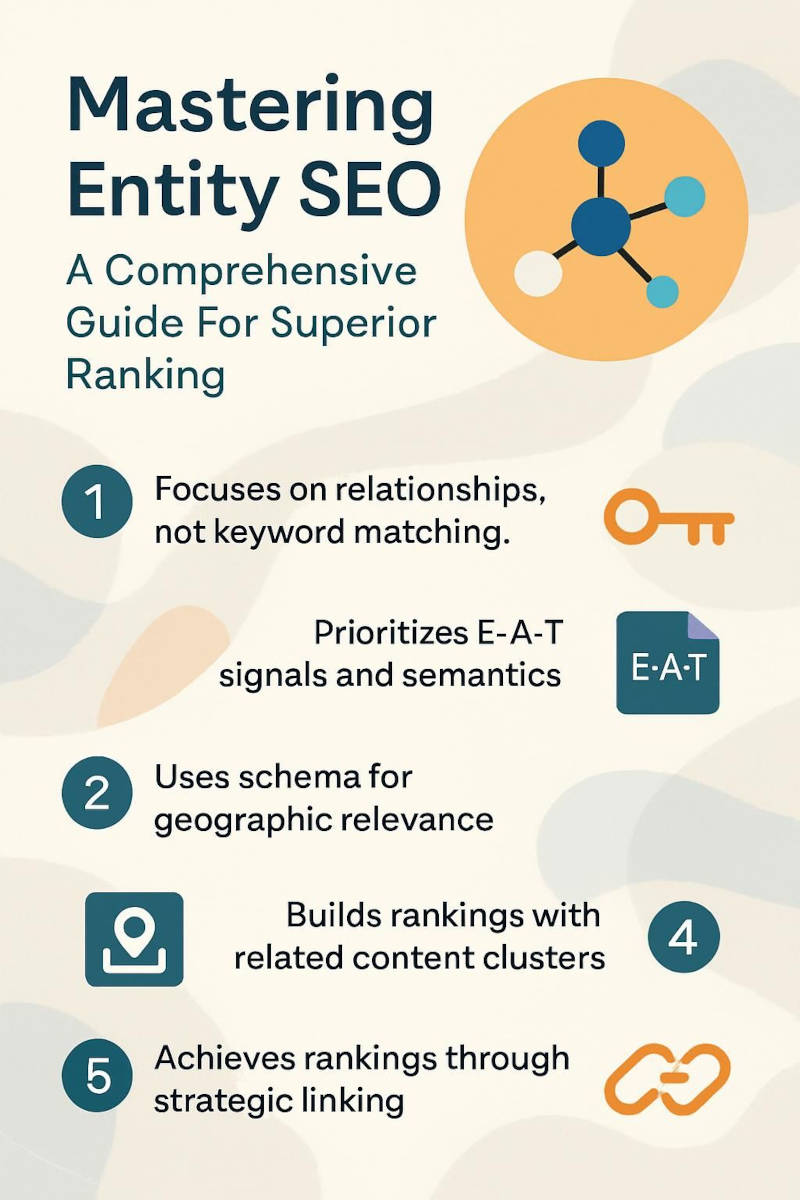
- Entity SEO focuses on connecting content to Google’s knowledge graph through relationships between concepts, people, places, and things rather than simple keyword matching.
- Local service providers can dominate search results by creating dedicated service pages, optimizing Google Business Profiles, and using schema markup for geographic relevance.
- Google now prioritizes E-A-T signals and semantic understanding over traditional keyword density, using machine learning models like BERT for better search results.
- Authority density measures expertise concentration in specific topics, with related content clusters building stronger rankings than scattered, unconnected pages across multiple subjects.
- All Seasons Roofing achieved top rankings for “Roofing Contractor Greenwich CT” despite low domain rating by implementing strategic internal linking and comprehensive sitemaps.
Common Misconceptions About Entity SEO
Many people think entity SEO just means stuffing keywords into content, but this approach misses the bigger picture of how search engines understand meaning and context. Others confuse entity SEO with basic keyword research, not realizing that Google’s knowledge graph works with concepts and relationships rather than simple word matching.
How Is Entity SEO Different from Topical Authority?
Entity SEO focuses on specific things, people, places, and concepts that search engines understand through knowledge graphs and structured data. Topical authority involves content silos and clusters to enhance a domain’s authority across broad subject areas.
Google’s knowledge graph connects entities through relationships, while topical authority builds expertise through comprehensive content coverage.
Search engines use named entity recognition and natural language processing to identify entities within your content. Content clusters group related articles around main topics, creating topical strength.
Entity SEO targets specific named entities that appear in knowledge panels, whereas topical authority spreads across entire subject domains through interconnected content pieces.
Entity SEO connects your content to Google’s vast knowledge network, while topical authority builds your site’s reputation through comprehensive subject coverage.

Who Should Use Entity SEO Strategies
Entity SEO works for many different types of businesses, from local service companies to large B2B organizations. Local businesses can use entity strategies to show up better in Google search results when people look for services in their area.
Online directories benefit by organizing their content around specific entities, which helps search engines understand what they offer. B2B companies can build authority by creating content that connects related topics and shows their expertise in specific areas.
Want to learn exactly how each type of business can use these strategies?
What Are Best Practices for Local Service Providers?
Local service providers need smart entity SEO strategies to compete in their markets. Google’s knowledge graph helps search engines understand your business better than basic keyword stuffing.
- Create dedicated service pages for each specific offering your business provides. Focus on location-based content that targets your service area with clear geographic signals.
- Build comprehensive location pages that showcase your expertise in specific neighborhoods or cities. Include local landmarks, zip codes, and area-specific information to strengthen geographic relevance.
- Develop internal linking structures that connect related service pages to your main business categories. Use sitemaps to help search engines discover how your services relate to each other.
- Optimize your Google Business Profile with accurate business information, service categories, and regular updates. Include photos of completed work and customer reviews to build local authority.
- Write content that demonstrates your expertise through case studies and project examples. Share specific details about materials used, techniques applied, and problems solved for local customers.
- Use schema markup to help search engines understand your business type, services offered, and coverage areas. This structured data improves your visibility in local search results.
- Create FAQ pages that answer common questions customers ask about your services. Target long-tail keywords that include your location and specific service terms.
- Build citations across local directories and industry-specific platforms to establish your business presence. Ensure your name, address, and phone number stay consistent across all listings.
- Generate authentic customer reviews on multiple platforms including Google, Yelp, and industry directories. Respond to reviews professionally to show active engagement with your community.

How Can Directories Benefit from Entity SEO?
Directories can achieve superior ranking by organizing content around relevant entities, which helps search engines understand their structure better. Entity-based organization allows directories to create clear relationships between businesses, services, and locations, making it easier for Google’s knowledge graph to process and display information.
Search engine optimization becomes more effective when directories group related entities together, such as restaurants in specific neighborhoods or service providers within particular industries.
This approach improves content discovery and helps directories appear in more relevant search results.
Location-based entity SEO helps directories serve localized search queries effectively, connecting users with businesses in their specific areas. Directories benefit from implementing entity linking strategies that connect local businesses to geographic entities, industry categories, and service types.
Machine learning algorithms can better understand the context of directory listings when entities are properly structured and annotated. Digital marketing efforts become more targeted when directories use entity extraction to identify key business attributes, services offered, and geographic coverage areas.
Entity SEO transforms directories from simple lists into intelligent, context-aware platforms that search engines can truly understand and recommend.
What Entity SEO Strategies Work for B2B Companies?
B2B companies need smart entity SEO strategies to reach their target audience and solve specific business problems. These tactics help build authority while connecting with potential clients through search engines.
- Create dedicated pages for each target audience segment and their unique business challenges, using controlled vocabularies that match industry terminology and search patterns.
- Build comprehensive internal linking structures between related service pages, case studies, and industry resources to establish topical authority within your business niche.
- Develop detailed company profiles with structured data markup, including JSON-LD schema to help Google’s knowledge graph understand your business relationships and expertise areas.
- Optimize meta tags and descriptions with industry-specific entities, incorporating terms like “B2B solutions” and relevant business categories that appear in search engine indexes.
- Publish case studies featuring client success stories, using named entity recognition to highlight specific companies, industries, and measurable results that demonstrate expertise.
- Create resource hubs around core business topics, linking related content pieces to build semantic relationships and improve information retrieval for target keywords.
- Use entity chunking in content creation, grouping related business concepts together while maintaining clear connections to your primary services and solutions.
- Implement proper annotations and structured markup for business locations, services, and team member expertise to enhance discoverability in local and industry searches.
- Build authority through consistent entity mentions across multiple content types, from blog posts to whitepapers, establishing clear semantic connections to your business domain.

Recent Changes in Google’s Search Priorities
Google keeps changing how it ranks websites, and these shifts affect how SEOs build their strategies. The search giant now focuses more on user intent and experience, moving away from simple keyword matching to understand what people really want when they search.
How Does Google Strive for Optimal Search Outcomes?
Google faces an excess of pages competing for the same keywords, which has shifted their focus dramatically. The search giant now prioritizes quality over quantity, making expertise and relevance the key factors for ranking success.
Machine learning models like BERT and neural networks help Google understand user intent better than ever before. These systems analyze content semantically, moving beyond simple keyword matching to grasp the true meaning behind search queries.
Search algorithms now evaluate content through multiple lenses, including E-A-T signals and entity relationships within Google’s knowledge graph. The company uses deep learning techniques to assess how well content matches what searchers actually want to find.
From my experience working with SEO tools, I’ve seen how Google’s transformers and word embeddings create more accurate search results. This shift means websites must demonstrate genuine expertise in their field rather than simply stuffing pages with keywords.

How Does Google Strive for Optimal Search Outcomes?
Google faces an excess of pages competing for the same keywords, which has shifted their focus dramatically. The search giant now prioritizes quality over quantity, making expertise and relevance the key factors for ranking success.
Machine learning models like BERT and neural networks help Google understand user intent better than ever before. These systems analyze content semantically, moving beyond simple keyword matching to grasp the true meaning behind search queries.
Search algorithms now evaluate content through multiple lenses, including E-A-T signals and entity relationships within Google’s knowledge graph. The company uses deep learning techniques to assess how well content matches what searchers actually want to find.
From my experience working with SEO tools, I’ve seen how Google’s transformers and word embeddings create more accurate search results. This shift means websites must demonstrate genuine expertise in their field rather than simply stuffing pages with keywords.
What Role Does E-A-T Play in Modern SEO?
E-A-T plays a crucial role in modern SEO by shifting focus from traditional backlinks to cumulative page scores. Google developed this framework to ensure higher quality and trustworthy search results across the web.
Domain authority now depends on expertise, authoritativeness, and trustworthiness signals rather than simple link counting. Search engines analyze content depth, author credentials, and site reliability to determine rankings in SERPs.
Content creators must demonstrate real expertise through detailed, accurate information that matches user intent. Google’s knowledge graph connects entities and concepts to verify content authenticity and relevance.
Sites with strong E-A-T signals often see better performance in web search results, especially for topics requiring specialized knowledge. The framework helps search engines distinguish between authoritative sources and low-quality content, making information retrieval more reliable for users seeking trustworthy answers.

How Does Google Assess Expertise?
Google uses complex systems to measure how well you know your topic, and these systems look at many different signals on your website. The search engine examines your content through advanced methods like tf-idf analysis, named entity disambiguation, and information retrieval techniques to understand if you truly grasp your subject matter.
Why Are Sitemaps and Keyword Analysis Important?
Sitemaps help Google understand the website’s structure and related topics, making your content easier to discover. Keyword density across multiple pages indicates expertise and relevance to search engines.
- XML sitemaps guide search engines through your site’s architecture, showing connections between related pages and topics that build topical authority.
- Proper keyword analysis reveals term frequency patterns that signal expertise to Google’s algorithms, similar to how tf-idf calculations work in information retrieval systems.
- Structured sitemaps help Google’s knowledge graph connect your content to relevant entities, reducing ambiguity about your site’s focus areas.
- Consistent keyword density across multiple pages shows deep knowledge in specific topics, which search engines interpret as authority signals.
- Sitemaps include meta information that helps search engines understand content relationships, improving your chances of appearing in relevant searches.
- Strategic keyword placement throughout your site creates semantic connections that parsing algorithms can identify and rank appropriately.
- Well-organized sitemaps reduce crawl errors and ensure important pages get indexed, maximizing your content’s visibility in search results.
- Keyword analysis helps identify content gaps where you can build authority, creating opportunities to dominate specific topic clusters.
- Sitemaps support entity-linking by showing how different pages relate to each other, strengthening your site’s overall semantic structure.

What Is Topical Authority?
Topical authority measures how much expertise you pack into your content about specific topics, and Google uses algorithms like PageRank and semantic analysis to figure out if your site really knows what it’s talking about.
Your content volume matters, but the connections between your topics matter even more – think of it like building a web where each piece of content strengthens the others through related keywords, entities, and semantic relationships.
Google’s knowledge graph pulls data from sources like Wikipedia, DBpedia, and Wikidata to understand these connections, so when you write about fly fishing rods, your authority grows stronger if you also cover tackle, saltwater fly fishing techniques, and related gear in depth.
The search engine uses tools like Word2Vec and explicit semantic analysis to map out these topic relationships, which means scattered content won’t build the same authority as focused, interconnected content clusters.
Keep reading to discover how successful companies use authority density to dominate their niches and outrank competitors who spread their content.
How Do Content Volume and Relatedness Affect Authority?
Content volume and topic relatedness work together to build stronger authority density in Google’s knowledge graph. Search engines use algorithms like PageRank and information retrieval systems to measure how much content you create around specific topics.
A pest control website discussing only pest control topics gains more authority than one mixing unrelated subjects like fly fishing or saltwater fly fishing. Google’s algorithms analyze your content using techniques like word2vec and explicit semantic analysis to understand topic connections.
Related content creates stronger semantic relationships that search engines can identify through vectors and POS tagging. Effective internal linking between related pages helps Google understand your site’s focus through sitemaps and keyword analysis.
Sites with focused content on specific topics like fly fishing rods or tackle build stronger topical clusters. This concentrated approach signals expertise to Google’s knowledge graph, which connects your content to entities in Wikipedia, Wikidata statements, and DBpedia databases.

Entity SEO Success Stories
Real companies have used entity SEO to boost their search rankings, and their results show what works. These case studies reveal specific tactics that businesses can copy to improve their own Google visibility.
How Did All Seasons Roofing & Gutters Implement Their Strategy?
All Seasons Roofing & Gutters built their entity SEO strategy around smart internal linking and detailed site mapping. Their team created a comprehensive sitemap that connected closely related roofing topics, making it easy for Google’s knowledge graph to understand their expertise.
The company focused on local search terms while maintaining strong connections between different service pages. This approach helped search engines recognize their authority in the Connecticut roofing market.
Their implementation resulted in top rankings for “Roofing Contractor Hunts Point” despite having a low domain rating. The strategy proved that small businesses can compete with larger companies by using entity SEO principles effectively.
Internal links guided visitors through related services, while the detailed sitemap showed search engines the depth of their roofing knowledge. This blueprint demonstrates how local service providers can boost their search engine rankings without massive SEO budgets.
Conclusion and Future Insights
Entity SEO transforms how businesses rank on Google, especially for local service providers and B2B companies. This strategy works better than cramming keywords onto single pages, and it builds real authority through connected content.
Google’s knowledge graph continues to evolve, making entity-based optimization more important each year. Smart businesses will focus on creating related service pages, proper sitemaps, and strong internal linking structures.
Success comes from understanding how search engines connect information, not just matching keywords.
FAQs
1. What is Entity SEO and how does it relate to Google’s Knowledge Graph?
Entity SEO focuses on optimizing content around specific entities that Google’s Knowledge Graph recognizes. This approach helps search engines understand your content better, which can improve your rankings on platforms like Amazon.com and WordPress sites.
2. How do machine learning models like CNNs and LSTMs impact Entity SEO?
CNNs and LSTMs help search engines process and understand content more effectively. These models, along with techniques like Naive Bayes and Hidden Markov Models, analyze vocabulary patterns to determine content relevance.
3. What role does Freebase play in modern SEO strategies?
Freebase provided structured data that helped build ontologies for better information retrieval. Kevin Rhodes and other SEO experts at Gadgetlesstech often reference how this foundation supports current entity recognition systems.
4. How can tools like ChatGPT and autocomplete features improve SEO content?
ChatGPT can help create entity-focused content while autocomplete reveals popular search patterns. These tools assist in building vocabulary that aligns with user intent and search behavior.
5. What technical concepts should marketers understand for Entity SEO success?
Marketers should grasp inverse document frequency, centrality measures, and how infobox data structures work. Understanding GloVe embeddings and information retrieval principles helps create more effective SEO content strategies.