The Gadgetlesstech Ranking System: Why Being “Findable” Isn’t Enough Anymore
For twenty years, ranking a local business online came down to one thing: get to the top of Google. Optimize a few pages, build some citations, gather reviews, and let the map pack do the rest.
This world is closing fast, and most business owners haven’t noticed yet. This is where the Gadgetlesstech Ranking System comes in.
Today’s Search Has Split in Two
Right now, a homeowner looking for an electrician in Blaine, Minnesota, or a family searching for a personal injury attorney in Bridgeport, isn’t just Googling it anymore. They’re asking ChatGPT. They’re asking Perplexity. An AI Overview shows up above every organic result, summarizing an answer before a single blue link is even visible. Increasingly, they don’t ask at all, they just talk to a voice assistant and take whatever business gets mentioned.
And that marks the end of traditional SEO as the only game in town, and the start of AEO and GEO: Answer Engine Optimization and Generative Engine Optimization. The old ranking factors haven’t disappeared. New ones have been layered on top of them, questions large language models are quietly asking behind the scenes while people search:
- Does this business have clear topical authority on the service being searched, or just a page that mentions the keyword?
- Is the business recognized as a distinct, well-defined entity, or is it getting confused with other companies that share a similar name?
- Is the content structured with enough semantic clarity that an AI model can confidently extract and reuse it as an answer?
- Does the business show up consistently across the Local Map Pack signals that both Google and AI systems draw from?
A business can be doing traditional SEO reasonably well and still be functionally invisible to the tools a growing share of customers now use to decide who to call. That’s not theoretical. It’s already happening across home services, legal, and local retail markets nationwide.
Why Most Fixes Don’t Actually Fix This
The usual response to AI search anxiety is more content: write more blog posts, add more keywords, hope volume adds up to visibility.
It doesn’t, for a simple reason: AI models don’t reward volume, they reward structure. When a generative engine puts together an answer about attic inspection cost in Fairfield County, it isn’t scanning for whichever page mentions attic inspections the most. It’s looking for the source that resolves the question most completely, in a format it can confidently lift and reuse: clear entities, clear intent mapping, clear semantic relationships between the query and the content answering it.
Most local businesses, and most agencies, are still optimizing for 2015 Google, not the version of search that exists right now.
The Gadgetlesstech Ranking System
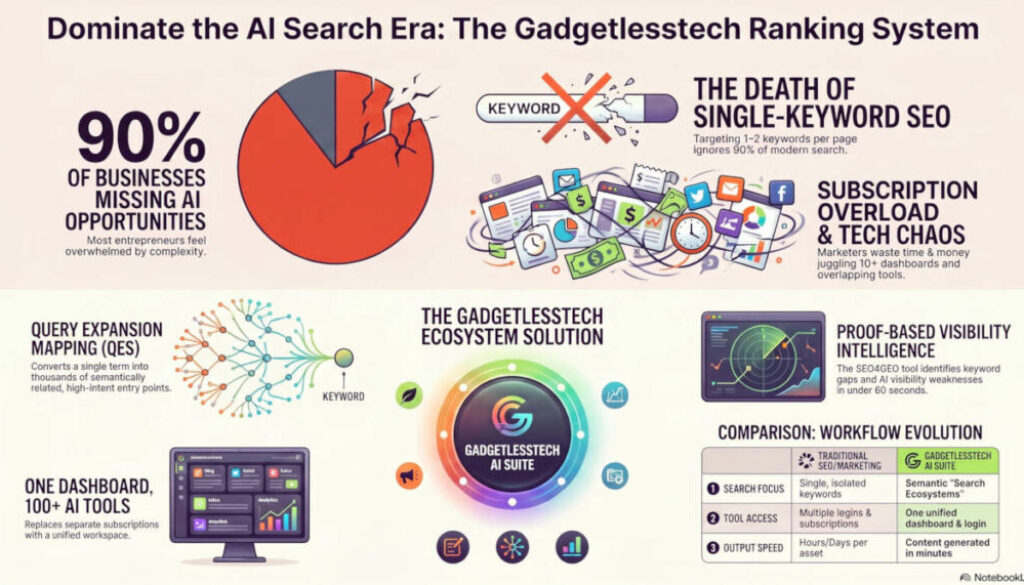
This is the gap the Gadgetlesstech Ranking System was built to close. It isn’t a single tactic, it’s four layers working together, each one solving a piece of the visibility problem that the layer above it depends on.
Layer 1: Query Expansion System (QES)
Before any content gets written, QES maps the full universe of how a topic actually gets searched, including the long-tail and semantically related variations, and the bottom-of-funnel searches that traditional keyword tools miss. It also builds the internal linking architecture that ties bottom-of-funnel service pages back to a central cornerstone page, so topical authority accumulates in one place instead of getting diluted across a dozen disconnected pages.
Layer 2: SEO4GEO
This is the audit layer. It scores a business against its actual top-3 competitors in the Google Map Pack across seven pillars: topical authority, search intent mapping, semantic SEO, entity SEO, query expansion, local map pack signals, and technical SEO fundamentals. The name is deliberate, it covers geographic SEO and Generative Engine Optimization at once, because right now those two things can’t be separated.
Layer 3: Gadgetlesstech AI Suite
Once the strategy is clear, this is where content, imagery, and supporting assets get produced at the speed the strategy actually requires. It’s the production engine that keeps cornerstone architecture and entity consistency intact across dozens of pages, instead of breaking down at scale, which is where most content plans quietly fail.
Layer 4: Agency Execution
Strategy and content mean nothing without disciplined execution: technical implementation, ongoing entity monitoring, schema markup, and the editorial judgment to know when a page needs a human hand instead of automation. This is where the first three layers get carried across the finish line and kept current over time.
Each layer exists because the one before it isn’t enough on its own. QES without SEO4GEO produces content with no benchmark. SEO4GEO without AI Suite produces a strategy that never gets built. And none of it matters without execution that actually gets it live, correctly, and kept current.
Who This Is Actually For
This system was built inside real client work, not in a vacuum. It’s been used to build cornerstone and service page architecture for HVAC and electrical contractors competing against entrenched local players, to solve entity disambiguation problems for a personal injury attorney sharing a market with three other same-named firms, and to build topical authority from scratch for a roofing company launched less than a year ago.
If your business depends on being found, understood, and trusted by both a human doing a Google search and an AI model summarizing an answer, that’s exactly the problem this system was built to solve.
Where to Go From Here
If you want to see where your business currently stands against the businesses actually beating you, that’s the right first conversation to have. Not a sales pitch, an honest look at the gap between where you rank today and where AI-era search is already heading.
Check your AI visibility gaps, and find out exactly where that gap is for your business.
- About the Author
- Latest Posts

Kevin Rhodes is the founder and lead of Gadgetlesstech, a digital marketing and SEO agency based in Stamford, Connecticut. He started Gadgetlesstech in 2010 as a consumer electronics e-commerce venture, then transitioned in 2014 toward web development and full-service digital marketing.
Today, under his leadership, the company helps businesses grow through search engine optimization, content marketing, custom web design (especially WordPress), and strategic digital marketing campaigns. Kevin is known for a hands-on approach to SEO and marketing strategy, and for building online visibility and lead generation for his clients.