
Voice Search Optimization for Local Businesses: How to Get Picked by Siri, Google and Alexa
Voice search optimization is the work of making your business the answer when someone asks a phone, smart speaker or car to find a local service, such as “Hey Siri, find an electrician near me.” Voice assistants usually read out one or a few results, not ten, so being the top answer matters more than ever.
The assistants themselves are changing fast. Google began replacing Google Assistant with Gemini on Android phones in September 2026, and Apple has agreed to use Google’s Gemini technology for a revamped Siri. But the places these assistants get local business information from haven’t changed much: your map listings, your reviews and the directories that describe your business.
This guide explains how voice assistants choose local businesses, how to optimize your listings and content for voice and how voice search is blending into AI search.
Key Takeaways
- Google’s assistant draws on Google Maps and your Business Profile, while Siri uses Apple Maps, which you manage through Apple Business Connect.
- Claim and complete your Google Business Profile, Apple Business Connect, Bing Places and Yelp listings with identical details.
- Recent reviews matter: 74% of consumers look for reviews from the last three months.
- Write question headings in natural language with a short, direct answer right underneath.
- AI tool use for local recommendations jumped from 6% to 45% in a year, and voice and AI search are merging.
What Is Voice Search Optimization?
Voice search optimization helps your business be easily found, understood and recommended by voice assistants when customers speak a question rather than type it in. The most common voice searches are full questions (e.g., “Who can fix my furnace today?”), which often get just one answer.
For a local service company, voice optimization consists of three areas: complete and consistent map listings, strong recent reviews, and website content that answers spoken questions directly. It overlaps heavily with ranking for “near me” searches.
How Do Voice Assistants Choose Local Businesses?
Voice assistants choose local businesses mainly from map and listing data, favoring businesses that are close, relevant and well reviewed. Each assistant has its own data sources:
| Assistant | Main Local Data Source | Listing to Claim |
|---|---|---|
| Google (Assistant and Gemini) | Google Maps and Google Business Profile | Google Business Profile |
| Siri | Apple Maps | Apple Business Connect |
| Alexa | Third-party local data partners, including Yelp | Yelp, plus Bing Places |
Since assistants usually read only one or a few results, the same signals that win Google’s Map Pack matter here. In Whitespark’s 2026 Local Search Ranking Factors survey of 47 local search experts, the top local pack factors were your primary Business Profile category, proximity to the searcher and keywords in your business title.
How Do You Optimize Your Business for Voice Search?
You optimize your business for voice search by claiming every map listing the assistants use, keeping your details identical everywhere and earning a steady flow of recent reviews.
Claim Every Map Listing the Assistants Use
- Google Business Profile. The foundation for Google’s assistant and Google Maps. Our Google Business Profile optimization service covers it.
- Apple Business Connect. Apple’s free tool for managing how your business appears in Apple Maps, which Siri uses.
- Bing Places. Microsoft’s business listings.
- Yelp. A major review platform and a long-standing source of local data for other services.
Fill in every field on each one: categories, services, hours, service area, photos and website.
Keep Your Details Identical Everywhere
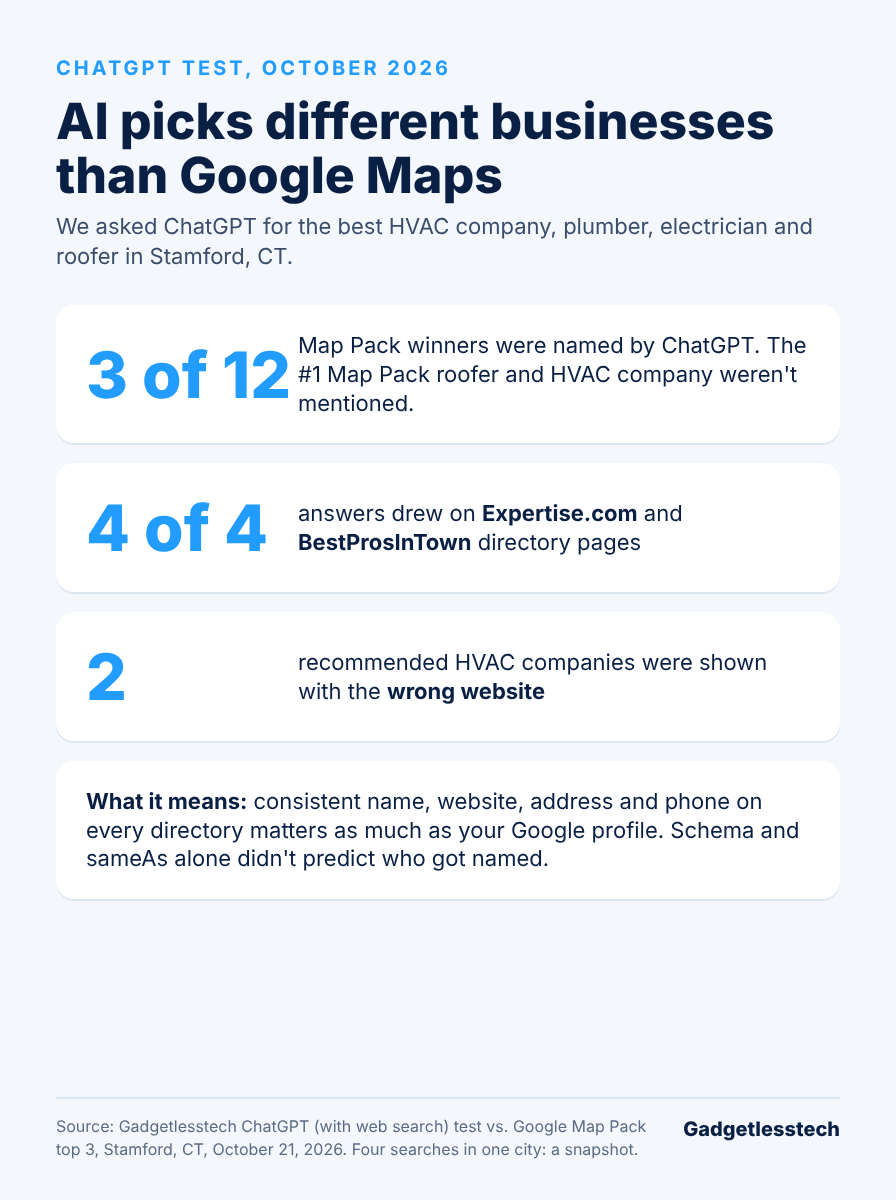
Use exactly the same business name, address, phone number, hours and website on every listing and on your own site. Mismatched details make it harder for assistants to trust that they have the right business. In our October 2026 test, ChatGPT printed the wrong website for two HVAC companies it recommended in Stamford, which is exactly what conflicting data produces. Audit your listings every few months and after any change to your phone, address or hours.
Earn Recent Reviews
Reviews help you rank and help people choose you once the assistant reads your name. In our October 2026 study of 59 Fairfield County service businesses, Map Pack winners had a median of 81 Google reviews versus 14 for nearby competitors outside the pack. BrightLocal’s Local Consumer Review Survey 2026 found 74% of consumers look for reviews from the last three months. Ask every customer, reply to every review and keep reviews coming on Google and Yelp.
How Do You Write Content That Answers Spoken Questions?
You write content for spoken questions by using headings phrased the way people talk and putting a short, direct answer right underneath each one.
- Phrase headings as real questions: “How much does a furnace tune-up cost in Stamford?” or “Do you offer emergency plumbing on weekends?”
- Answer in the first sentence or two, in about 40 to 60 words, then add detail.
- Use plain, conversational language at an easy reading level.
- Add an FAQ section to service pages with the questions callers ask most.
- Include your service area naturally, since many spoken searches include “near me” or a town name.
- Add LocalBusiness schema so your hours, phone and location are clearly labeled. Our schema markup guide shows how.
- Keep pages fast on phones, since voice searchers are usually on mobile.
How Is Voice Search Changing With AI Assistants?
Voice search is merging with AI search, as assistants move from reading a single listing to holding a conversation and building answers from many sources. Google began replacing Google Assistant with Gemini on Android starting September 4, 2026, and Apple has a deal to use Google’s Gemini technology in its upgraded Siri.
People are already using AI to find local businesses. BrightLocal’s 2026 survey found that use of ChatGPT and other AI tools for local business recommendations jumped from 6% to 45% in a year.
AI answers don’t always match the Map Pack, though. When we asked ChatGPT for the best HVAC company, plumber, electrician and roofer in Stamford in October 2026, it named only 3 of the 12 Map Pack businesses and built its answers from directories such as Expertise.com and BestProsInTown. As assistants become more AI-driven, being complete and consistent on those directories matters as much as your Google profile. Our answer engine optimization services cover this.
Conclusion
Voice search optimization for a local business is mostly about being easily found and easily trusted. Complete all of the sections on your Google, Apple, Bing and Yelp listings, make certain each one has exactly the same information, keep new customer reviews coming, and create answer-first content for the questions customers ask out loud. Those same concepts still apply as assistants shift to AI. Learn more about our AI search optimization services.
Want to see how your business shows up today? Request a free SEO4GEO audit from Gadgetlesstech in Stamford, CT. It compares your business with your top three Google Maps competitors across seven pillars and shows you what to fix first.
- About the Author
- Latest Posts

Kevin Rhodes is the founder and lead of Gadgetlesstech, a digital marketing and SEO agency based in Stamford, Connecticut. He started Gadgetlesstech in 2010 as a consumer electronics e-commerce venture, then transitioned in 2014 toward web development and full-service digital marketing.
Today, under his leadership, the company helps businesses grow through search engine optimization, content marketing, custom web design (especially WordPress), and strategic digital marketing campaigns. Kevin is known for a hands-on approach to SEO and marketing strategy, and for building online visibility and lead generation for his clients.