
AI Content Creation: How to Use AI Without Hurting Your Rankings
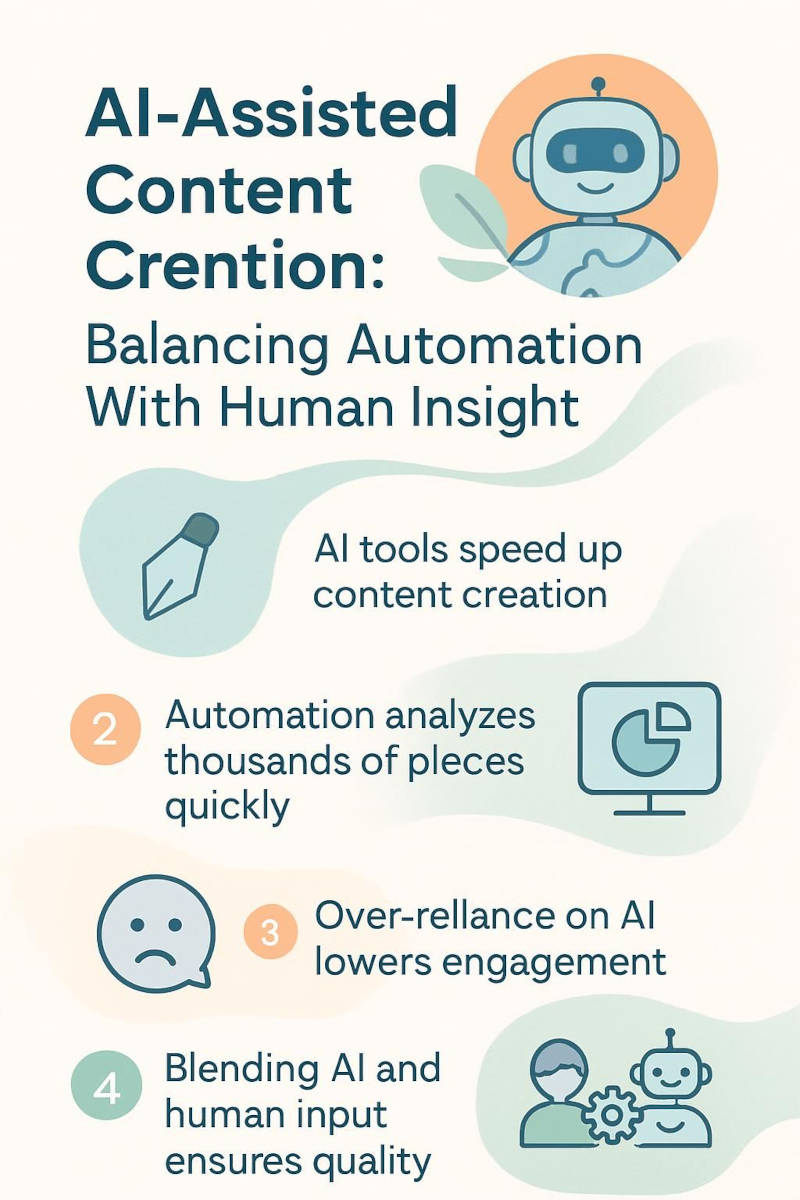
AI content creation is the use of artificial intelligence tools, such as large language models, to research, outline, draft, edit, and repurpose content, with people setting the strategy and checking the facts before anything is published. Used that way, it speeds up production without giving up the accuracy and experience that search engines and readers look for.
Interest is real but uneven. In Google Ads data we pulled for the United States in November 2026, “ai content creation” averaged 1,300 searches a month, peaking at 2,900 in January 2026 and falling to 880 by October. For most businesses, the real question is no longer “can AI write this?” but “how do we use it without hurting our rankings?”
This guide answers that second question. It covers how AI content creation works, what Google’s own policies say, where AI falls short, what it costs, and the review workflow we use on every page we publish.
Key Takeaways
- AI content creation means AI does the drafting and sorting while people own strategy, facts, and final edits.
- Google does not ban AI content. It treats content made mainly to manipulate rankings as spam, however it was produced.
- Since October 2026, Google’s guidance says AI output should be manually fact-checked before publishing, including titles, meta descriptions, structured data, and alt text.
- The biggest risks are factual errors, generic sameness, and publishing at scale without adding anything new.
- The tools are cheap. The real cost of AI content creation is the human time spent researching, verifying, and adding first-hand experience.
What Is AI Content Creation?
AI content creation is producing written, visual, audio, or video content with help from AI models that generate text, images, or speech from a prompt. For most businesses it means using tools like ChatGPT, Claude, or Gemini for outlines and first drafts, and tools like Grammarly or Canva for editing and design, while a person decides what to publish.
Google’s own guidance gives a useful definition of where AI fits. Its page on using generative AI content on your website says AI can be especially useful for researching a topic and adding structure to original content. That is a helper role, not an author role, and it is the frame we use in this guide.
What is the difference between AI-assisted and AI-generated content?
AI-assisted content is written or directed by a person who uses AI for parts of the job, such as research, outlining, or editing. AI-generated content is produced mostly by the model, with little human input beyond the prompt. The difference is who supplies the substance: the facts, the experience, and the judgment.
| AI-Assisted Content | AI-Generated Content | |
|---|---|---|
| Who sets the angle | A person, based on audience and goals | The prompt and the model’s defaults |
| Where facts come from | Verified sources and first-hand data | The model’s training data, unverified |
| Human review | Every claim checked before publishing | Light or none |
| Typical risk | Slower than full automation | Errors, sameness, and scaled content abuse |

How Does AI Content Creation Work?
AI content creation works in stages: a person defines the topic and audience, AI helps research and draft, and a person verifies, edits, and publishes. The model predicts likely words based on its training, so it is fast at producing structure and fluent text but cannot confirm on its own whether what it wrote is true.
Google makes this point directly. Its generative AI guidance explains that generative models predict a likely sequence of words rather than retrieving facts, which is why their output can contain errors. Here is how the work splits in practice:
| Stage | What AI Handles Well | What a Person Must Do |
|---|---|---|
| Research | Summarizing topics, listing subtopics and common questions | Confirm facts against primary sources |
| Outline | Proposing a heading structure | Match headings to real search queries and intent |
| Draft | Turning the outline into readable paragraphs | Add first-hand experience, data, and examples |
| Edit | Grammar, clarity, and tone suggestions | Protect accuracy and brand voice |
| Metadata | Drafting titles, descriptions, and alt text | Fact-check them like the body copy |
| Repurpose | Turning one article into posts, emails, or scripts | Check each version still says the same true thing |
For a list of tools by job, see our roundup of 15 AI tools for SEO.
Does Google Penalize AI Content?
No, Google does not penalize content simply because AI helped make it. Google penalizes content created mainly to manipulate search rankings, and its spam policies apply whether that content came from AI, human writers, or both. Quality and purpose decide the outcome, not the tool.
The official position has been consistent since 2023 and has grown more specific each year:
| Date | What Google Said | Source |
|---|---|---|
| Feb 8, 2023 | Using automation, including AI, to generate content mainly to manipulate rankings violates its spam policies. Google rewards helpful content however it is produced. | Google Search Central Blog |
| Mar 5, 2024 | New scaled content abuse policy covering many pages made to manipulate rankings, whether by automation, people, or both. | Google Search Central Blog |
| May 15, 2026 | Spam policies clarified to apply to generative AI responses in Search, including AI Overviews and AI Mode. | Google spam policies |
| Oct 1, 2026 | Generative AI guidance updated: manually fact-check and review all AI-generated content, including metadata, before publishing. | Google Search Central |
The practical rule follows from that record. If AI helps you publish accurate, original pages faster, you are inside Google’s guidelines. If AI helps you publish hundreds of thin pages that add nothing new, you are describing scaled content abuse, and Google says sites that violate its spam policies may rank lower or disappear from results. Google’s broader ranking changes are covered in our post on the next Google search ranking update.
Should you disclose that content was made with AI?
Google suggests considering it. Its generative AI guidance recommends adding information on how your content was created where readers would reasonably want that context, and its 2023 guidance frames this as explaining the “who, how, and why” behind a page. A short note on process, plus a real author name and bio, is usually enough for a business blog.

What Are the Benefits of AI Content Creation?
The main benefits of AI content creation are speed on first drafts, faster research and outlining, consistent editing, and easier repurposing. These gains are largest on structured, repeatable work, and smallest on work that depends on original reporting or expertise.
- Faster first drafts: A model can turn a solid outline into readable paragraphs in minutes, so writers start by editing instead of facing a blank page.
- Quicker research: AI can summarize a topic and list the questions people ask, which speeds up planning. The facts still need checking.
- Better structure: AI is good at proposing headings and spotting gaps in an outline, the “adding structure” use Google itself describes.
- Consistent editing: Grammar and tone tools catch the small errors that slip through on deadline.
- Easier repurposing: One researched article can become social posts, an email, and a video script without starting over.
Those benefits compound inside a plan. AI makes it practical to cover a topic in depth, which is how sites build topical authority, as long as each page still earns its place.

What Are the Limitations of AI Content Creation?
The main limitations of AI content creation are factual errors, generic content that repeats what already ranks, no first-hand experience, and new risks introduced by AI editing tools. Each one is manageable with human review, but none of them fixes itself.
- Confident errors: Models can state wrong figures, dates, and citations fluently. Google’s own guidance gives this as the reason to fact-check everything.
- Sameness: Models learn from what already exists, so unedited drafts tend to repeat the consensus. Pages that add nothing new give Google and AI search little reason to choose them.
- No experience: AI has never run your business, met your customers, or finished a project. That first-hand detail is what readers trust and what rivals can’t copy.
- Weak local knowledge: Models know less about small towns, local rules, and recent changes than about national topics.
Do AI humanizer tools make content safer?
In our experience, not reliably. On our own pages we have tested AI “humanizer” rewriting as a final step, and it repeatedly changed meaning: swapping figures, inventing attributions, and softening claims that had been checked. We now reject any rewrite that alters a fact and keep the verified original. Detection scores also told us little, since pages we had researched and fact-checked line by line still scored as likely AI. Accuracy is the standard Google states, so that is the one we work to.

How Do You Use AI for Content Without Losing Quality?
To use AI for content without losing quality, let AI speed up research, structure, and drafting, then put every page through human checks for search intent, accuracy, originality, and metadata before it goes live. This is the workflow we run on every page at Gadgetlesstech:
- Start with real search data. Pull keyword volumes and live search results so each page targets one clear intent and no two pages compete for the same term.
- List what you can add. Before drafting, write down the first-hand data, experience, or local detail this page will have that the current top results don’t.
- Outline around real questions. Use the questions from search results as headings and answer each one in the first sentence or two.
- Draft with AI, then rewrite with experience. Treat the AI draft as raw material. Replace generic lines with your numbers, process, and examples.
- Cite primary sources only. Link to the agency, study, or official documentation, not a blog summarizing it.
- Fact-check everything, metadata included. Check every number, date, and name, plus the title, meta description, schema, and image alt text.
- Publish under a real author. Name the person responsible and, where it helps readers, note how the page was made.
For how these pages fit together into a plan, see our guides on content marketing strategy and long-tail content clusters.
How Much Does AI Content Creation Cost?
AI content creation is cheap in software and expensive in time. Many AI writing tools offer free tiers or low monthly subscriptions, but the cost that decides quality is the human time spent on research, fact-checking, and adding experience. A page that skips that time costs little and is worth about as much.
When you compare options, price the whole workflow, not just the tool:
| Approach | What You Pay For | What You Get |
|---|---|---|
| DIY with AI tools | Tool subscriptions plus your own hours | Fast drafts; quality depends on how much time you put into review |
| Freelance writer using AI | Per article or per word | Varies widely; ask how facts are checked |
| Agency content program | Strategy, research, writing, and review time | Pages planned around search data and verified before publishing |
At Gadgetlesstech, content work is billed at $125 an hour, and most of those hours go into research and verification rather than drafting. See our content marketing services for what that includes.
Does AI-Created Content Show Up in AI Search?
Yes, if it is accurate, specific, and clearly answers the question. ChatGPT, Perplexity, and Google AI Overviews cite pages that answer a question directly and add something other pages don’t. How the page was drafted matters less than whether it is worth citing.
That raises the bar for AI-assisted content rather than lowering it. A model summarizing the same sources as everyone else produces a page an AI answer engine has no reason to quote. Specific data, named sources, and first-hand detail are what get pulled into answers. Our guide on how to get cited by ChatGPT covers this in depth, and our generative engine optimization services put it into practice.
The Bottom Line on AI Content Creation
AI content creation works best as a production tool inside a human-led process. Let AI handle research summaries, outlines, drafts, and repurposing. Keep people in charge of strategy, facts, experience, and the final edit. Google’s guidance, from its 2023 statement to its October 2026 fact-checking update, points the same way: the method is allowed, and the quality is what gets judged.
AI can speed up your content, but it can’t supply your experience or check its own facts. At Gadgetlesstech, we combine AI-assisted drafting with search data, primary-source research, and line-by-line fact-checking, so every page is built to rank in Google and get cited in AI search. If you want content produced that way, book a strategy call.
- About the Author
- Latest Posts

Kevin Rhodes is the founder and lead of Gadgetlesstech, a digital marketing and SEO agency based in Stamford, Connecticut. He started Gadgetlesstech in 2010 as a consumer electronics e-commerce venture, then transitioned in 2014 toward web development and full-service digital marketing.
Today, under his leadership, the company helps businesses grow through search engine optimization, content marketing, custom web design (especially WordPress), and strategic digital marketing campaigns. Kevin is known for a hands-on approach to SEO and marketing strategy, and for building online visibility and lead generation for his clients.