Content Marketing Strategy for Local Service Businesses: What to Publish and Why
A content marketing strategy is your written plan for what your business publishes, who it’s for, where it lives and how you’ll know it’s working. For a local service business, the point isn’t traffic for its own sake. It’s calls, booked jobs and customers who already trust you before they pick up the phone.
Most service businesses skip the plan and post whatever comes to mind. The result is a blog nobody finds. The fix starts with knowing what your customers actually search for, and the answer is often more specific than you’d expect.
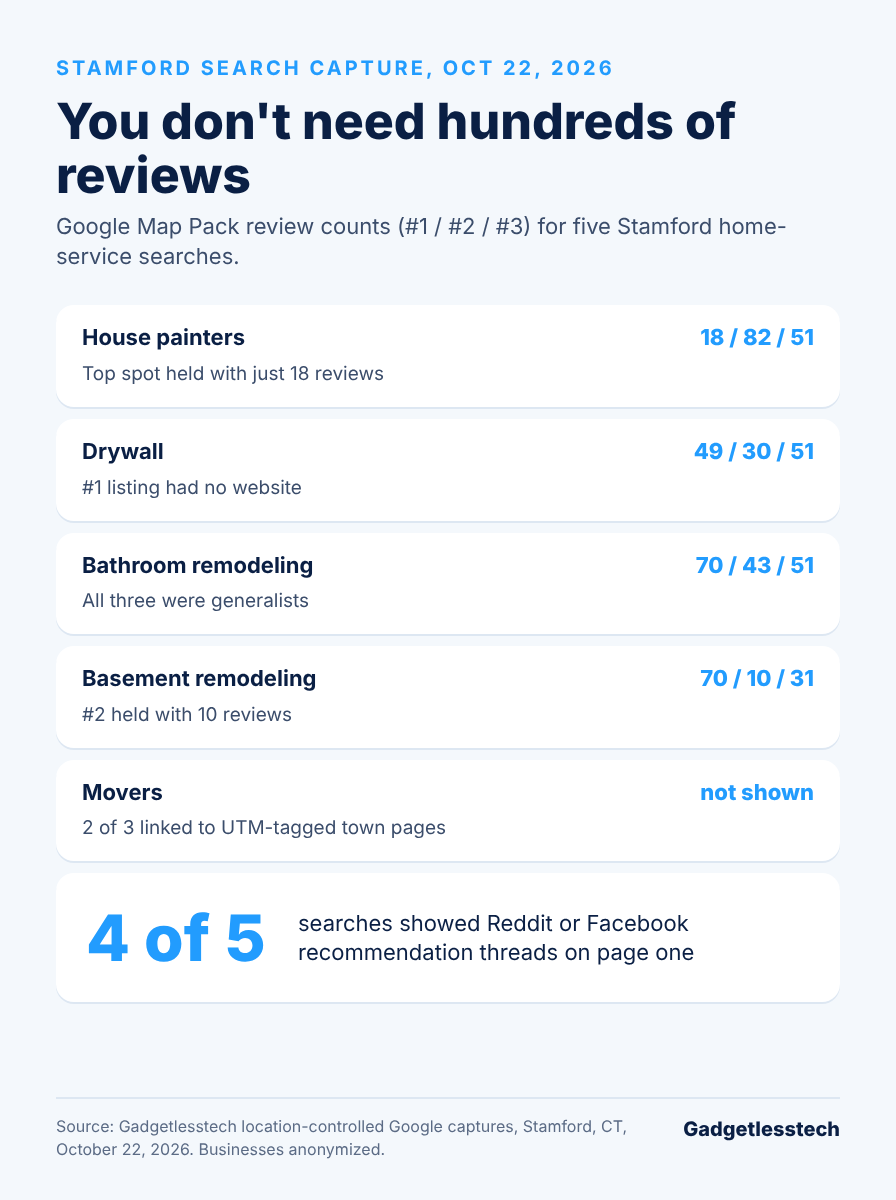
On October 22, 2026, we captured the Google results for five common home-service searches in Stamford, CT. Price questions dominated. Neighbors’ recommendation threads ranked on page one. A local renovation video ranked. And a remodeler’s plain cost answer earned it a top-three organic spot. This guide shows you how to turn patterns like those into a content plan that brings in work.
Key Takeaways
- Cost questions dominated the People Also Ask boxes in our Stamford captures for painting, bathroom, basement and moving searches.
- A basement remodeler’s own page ranked third organically by answering cost directly.
- Reddit and Facebook community threads ranked on page one for four of the five searches.
- Build cost, process and town pages first, then blog posts that support them.
- Measure content by calls and form leads from each page, not by visits alone.
What Is a Content Marketing Strategy?
A content marketing strategy is a written document that outlines how your published content relates to your business objectives: getting more phone calls for the services you are trying to sell in the towns where you wish to work. It addresses four questions:
- What will you publish? Cost guides, service and town pages, project galleries, FAQs, videos.
- Who is it for? The homeowner or business owner who is about to hire someone like you.
- Where will it live? Your website first, then your Business Profile, YouTube and social channels.
- How will you measure it? Calls and form leads from each page, rankings and impressions in Search Console.
Writing one helps ensure that you create content that will earn you work, versus content that simply fills up space on your calendar. Our content marketing services create and maintain plans like this for local businesses. While our AI Suite can assist with drafting posts, images and social media content once the plan is set, each of those pages requires actual information about your business.
What Content Do Local Service Customers Actually Search For?
Local service customers search for price, process and proof before they hire. Here is what we saw in our October 22, 2026 Google captures in Stamford for house painters, drywall contractors, bathroom remodeling, basement remodeling and moving companies:
| What We Saw | What It Means for Your Content |
|---|---|
| People Also Ask questions were dominated by cost in painting, bathroom, basement and moving searches | Publish an honest cost guide for each main service |
| A basement remodeler’s own page ranked third organically with a direct cost answer | Plain, specific answers can beat big national sites |
| Two local painters’ Stamford service-area pages ranked on page one | Town pages with real local detail earn rankings |
| A YouTube video of a Stamford bathroom renovation ranked on page one | Short project videos are worth making |
| Reddit and Facebook recommendation threads ranked for four of the five searches | Homeowners trust neighbors, so earn genuine word of mouth |
Reviews are part of this research too. BrightLocal’s Local Consumer Review Survey 2026 found that 97% of consumers read reviews for local businesses, and Google’s share as a review source fell from 83% to 71% in a year. Homeowners look in more places than one, so highlight real reviews on your own pages too.
How Do You Build a Content Marketing Strategy Step by Step?
You build a content marketing strategy by starting with the services you want to sell and working outward to the questions customers ask about them.
- Pick your money services. The two to five services that bring in the most profit or that you most want to grow.
- Audit what you already have. List your current pages, check which ones get impressions in Search Console and which ones overlap, then update or merge them before writing anything new.
- Collect real customer questions. Write down what callers ask, check the searches in Search Console and note the People Also Ask questions for your service and town.
- Map one page per question or intent. Never let two pages target the same search, or they’ll compete with each other.
- Build the core pages first: a service page for each money service, a cost guide, a town page for each area you serve and a project gallery.
- Add supporting blog posts that answer narrower questions and link back to the matching service page.
- Publish on a schedule you can keep. One strong page a month beats ten thin ones followed by silence.
- Refresh pages every year, especially cost guides and seasonal pages.
Linking related pages together into a cluster around each service builds topical authority, which helps Google see that you cover the subject completely.
Which Content Types Work Best for Service Businesses?
The content types that work best for service businesses answer a real search and help the customer decide.
| Content Type | The Search It Answers | Where It Helps |
|---|---|---|
| Cost guides | “How much does [service] cost in [town]?” | Organic results, AI answers, conversions |
| Service pages | “[Service] near me” | Organic results, Map Pack relevance |
| Town pages | “[Service] in [town]” | Organic results, Map Pack relevance |
| Project galleries | “What will it look like?” | Conversions, image search |
| FAQ answers | Specific questions about process, timing and permits | Organic results, AI answers |
| Short project videos | “How is this done?” | YouTube, organic results, trust |
| Case studies | “Has this company done a job like mine?” | Conversions, trust (use real numbers only) |
| Review highlights | “What do customers say?” | Conversions, trust |
If you write case studies, only use real results with real before and after numbers, and keep client details private if they prefer.
How Does Content Help You Show Up in AI Answers?
Content helps you show up in AI answers when it gives clear, direct answers that AI tools can quote, and when your business facts match across the web. In our October 2026 test, ChatGPT named only 3 of the 12 businesses in Google’s Stamford Map Pack across four trades, and it built its answers from directory listings.
- Answer first. Put a direct one- or two-sentence answer right under each question heading.
- Make each section stand alone. AI tools often lift a single passage, so repeat your business name, service and town rather than saying “as mentioned above.”
- Keep business facts consistent on your site and every directory.
- Be on the directories AI reads for your trade and town.
A note on FAQ markup: Google ended FAQ rich results for all sites as of May 7, 2026, so FAQs no longer produce the expandable result in Google Search. The on-page answers still help people and AI tools, which is the real point. Our AI search optimization services cover the rest.
How Do You Measure Content Marketing Results?
You measure content marketing results by tracking what each page brings in, not just how many people visit.
- Search Console: impressions, clicks and the queries each page ranks for.
- Calls and form leads by page: use call tracking and record the landing page on every form submission.
- GA4 key events and conversion paths: see which content pages people read before they contact you.
- Links and mentions earned: cost guides and local data often attract links from other sites.
- Booked jobs: the number that matters most. Review it every quarter.
Check pages that get impressions but few clicks, and rewrite their titles and opening answers. Check pages that get visits but no leads, and make the call to action clearer.
Conclusion
A content marketing strategy for a local service business begins with the services you wish to sell and the questions potential customers ask before they hire: what it costs, how it works, and whether they can trust you. First create cost guides, service and town pages, galleries and short videos. Then support them with blog articles. Track each page by the number of phone calls and leads it creates. Learn more about our local SEO services for Connecticut businesses.
Want to see the content gaps between you and your competitors? Request a free SEO4GEO audit from Gadgetlesstech in Stamford, CT. It compares your business with your top three Google Maps competitors across seven pillars and shows you what to publish first.
- About the Author
- Latest Posts

Kevin Rhodes is the founder and lead of Gadgetlesstech, a digital marketing and SEO agency based in Stamford, Connecticut. He started Gadgetlesstech in 2010 as a consumer electronics e-commerce venture, then transitioned in 2014 toward web development and full-service digital marketing.
Today, under his leadership, the company helps businesses grow through search engine optimization, content marketing, custom web design (especially WordPress), and strategic digital marketing campaigns. Kevin is known for a hands-on approach to SEO and marketing strategy, and for building online visibility and lead generation for his clients.