Google Business Profile SEO: How to Rank Higher in the Map Pack
Google Business Profile SEO is the work of optimizing your free Google listing so it shows up in the Map Pack and on Google Maps when people nearby search for what you do. For most local service businesses, that Map Pack spot is where the calls come from.
The good news is that you control most of what decides who gets those three spots. In our October 2026 study of Google Map Pack winners in Stamford, Norwalk and Bridgeport, the winners had more reviews and better-kept profiles, not fancier websites. And some won with surprisingly few reviews because their category and location fit the search.
This guide explains what ranks a Business Profile, how to optimize yours step by step, how many reviews you need, what our study found and how to track your results.
Key Takeaways
- Google ranks local results on relevance, distance and prominence.
- Whitespark’s 2026 expert survey ranks your primary category as the top Map Pack factor, followed by proximity and keywords in the business title.
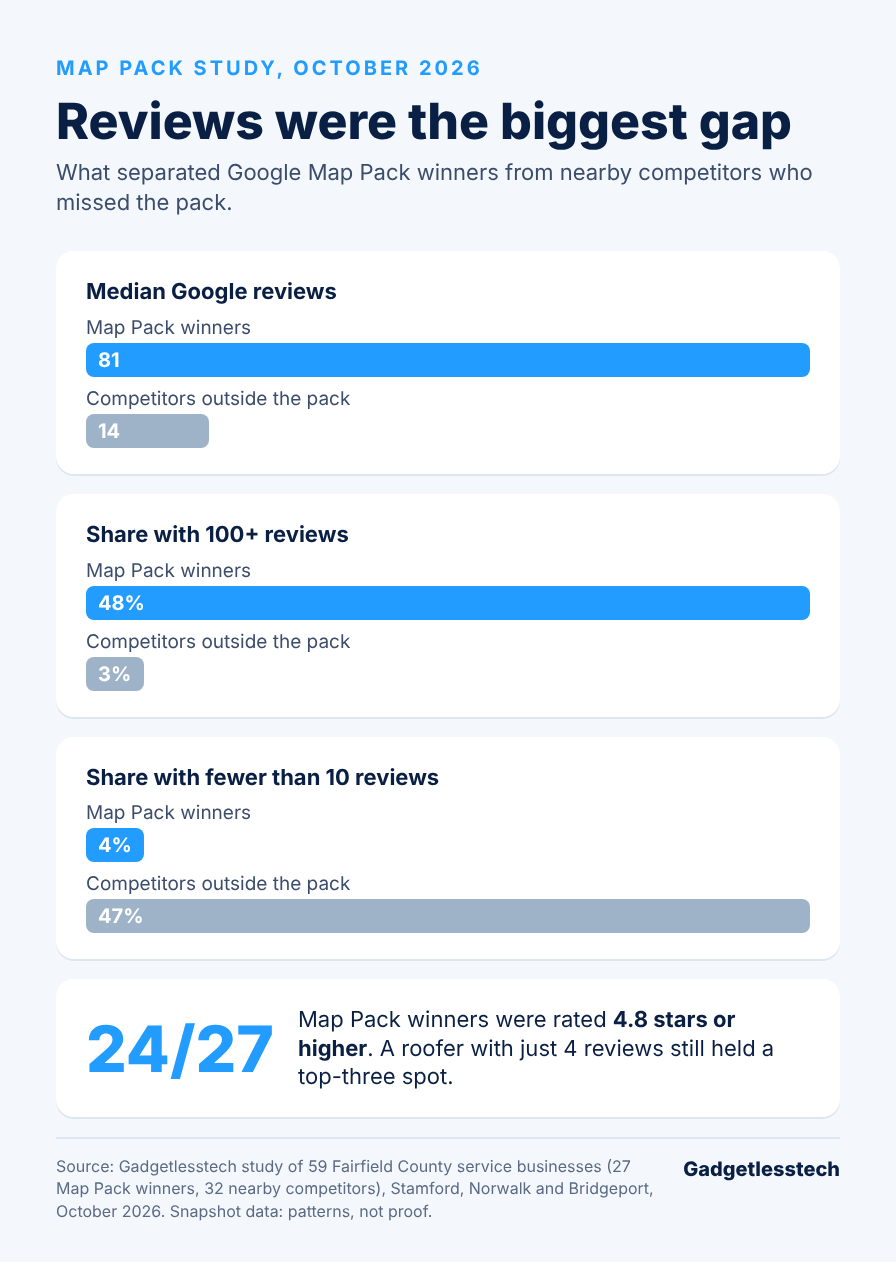
- Map Pack winners in our study had a median of 81 Google reviews versus 14 for nearby competitors, and 24 of the 27 winners were rated 4.8 or higher.
- A roofer with 4 reviews and a roofer with no website still held top-three spots, so proximity and category can outweigh volume.
- Only 5 of 26 winners with websites tagged their profile link for tracking, which is an easy edge.
What Is Google Business Profile SEO?
Google Business Profile SEO is enhancing your listing’s categories, details, photos and reviews so that Google displays it when people look for the services you offer. Your profile shows up in the Map Pack (the three businesses shown with a map), as well as on Google Maps and on any search for your company name.
It works alongside your website and your broader local SEO, but the most common first point of contact for customers looking for local service businesses is your profile. Our Google Business Profile optimization services manage all of this for you.
What Ranks a Google Business Profile in the Map Pack?
Google says local results are based mainly on three things, as explained in its guide to local ranking: relevance (how well your profile matches the search), distance (how close you are to the searcher) and prominence (how well known and well reviewed you are). Expert surveys add detail. Here is how the top factors from Whitespark’s 2026 Local Search Ranking Factors survey of 47 experts line up:
| Factor | Whitespark 2026 Score | What You Control |
|---|---|---|
| Primary category | 227 (top factor) | Pick the most specific category for your main service |
| Proximity to the searcher | 225 | Your real address or service area; you can’t move closer, but you can be relevant in more towns |
| Keywords in the business title | 223 | Use your real business name only; adding keywords breaks Google’s guidelines |
| Reviews | Strong prominence signal | Ask every customer, reply to every review, keep them recent |
| Profile completeness | Supports relevance | Fill in services, hours, service areas and attributes |
| Photos and updates | Supports trust and engagement | Add real job photos and updates regularly |
Expert scores are opinions, not Google’s own numbers, but they agree with what we saw in our study.
How Do You Optimize Your Google Business Profile Step by Step?
You optimize your Google Business Profile by selecting the correct categories, filling out every field, adding real photos and regular updates, and tagging your website link so you can track results.
Choose the Right Primary and Secondary Categories
Your primary category tells Google what your business mainly is, and experts consider it the most important thing you can control. Select the most specific option for your main category (e.g., “plumber” instead of “contractor,” “roofing contractor” instead of “construction company”). Review what your top three Map Pack competitors use, and add secondary categories only if you actually offer those services.
Complete Every Field, Service and Area
- Business name: exactly as you use it in real life. Google’s guidelines don’t allow adding keywords or towns.
- Services: list each one, with a short description.
- Service areas: the towns you actually serve.
- Hours: accurate, including holiday hours.
- Phone: a local number you answer.
- Website: link to your homepage or the most relevant location page.
- Description and attributes: what you do, who you serve and what makes you different.
Add Real Photos and Regular Updates
Current pictures of your staff, vehicles and completed projects help build customer confidence. Add new photos each month, as well as updates about seasonal services or special deals. Stock photos should never be used to stand in for your own work. Two of the winners in our study also took bookings directly through their profile, which turns a Maps view into a scheduled job.
Tag Your Website Link for Tracking
Add UTM tracking codes to your profile’s website link so visits from Maps show up separately in Google Analytics. For example: yoursite.com/?utm_source=google&utm_medium=organic&utm_campaign=gbp. In our study, only 5 of the 26 Map Pack winners with websites did this, so most businesses can’t tell which calls and leads their profile produces.
How Many Google Reviews Do You Need to Rank?
There is no fixed number of Google reviews you need to rank, but more recent, genuine reviews clearly help. In our October 2026 study, Map Pack winners had a median of 81 reviews versus 14 for nearby competitors outside the pack. Still, a roofer with only 4 reviews held a top-three spot, because proximity and category mattered more for that search.
| Review Count | Map Pack Winners | Competitors Outside the Pack |
|---|---|---|
| 100 or more reviews | 48% | 3% |
| Fewer than 10 reviews | 4% | 47% |
| Median reviews | 81 | 14 |
Recency matters to customers too. BrightLocal’s Local Consumer Review Survey 2026 found 74% of consumers look for reviews from the last three months.
- Aim to pass your local top three, then keep new reviews coming every month.
- Ask right after the job, with a direct review link.
- Reply to every review personally.
- Never buy reviews or offer rewards for them, and don’t screen out unhappy customers. Google’s policies prohibit all three. Our page Do Google reviews help local SEO rankings? goes deeper.
What Our Study Found About Map Pack Winners
We studied 27 Map Pack top-three listings in Stamford, Norwalk and Bridgeport in October 2026, across HVAC, roofing, plumbing, electrical, landscaping and kitchen remodeling, and compared them with 32 nearby competitors outside the pack.
- Reviews were the biggest gap: a median of 81 for winners versus 14.
- Ratings were high: 24 of the 27 winners were rated 4.8 or higher.
- Proximity can beat volume: a roofer with 4 reviews and a roofer with no website both held top-three spots.
- Websites helped but weren’t required: 26 of the 27 winners had one.
- Tracking was rare: only 5 of the 26 winners with websites used UTM codes on their profile link.
- Online booking was rare: only 2 winners offered it through their profile.
- Website basics didn’t decide it: competitors outside the pack matched or beat winners on title tags, headings, schema and speed.
One caveat: this is a snapshot of one region, so it shows patterns, not proof. Still, the pattern is clear. A complete profile, the right category and a steady flow of strong reviews move you toward the top three. Our guide to ranking higher on Google Maps has more.
How Do You Track Google Business Profile Performance?
You track Google Business Profile performance with the profile’s own performance report, UTM-tagged links in Google Analytics and regular rank checks across your service area.
- Performance report: check searches, views, calls, direction requests, website clicks and bookings every month.
- Search terms: see which searches people used to find you.
- Google Analytics: with UTM codes on your website link, see how many visits and leads came from the profile.
- Call tracking: record calls by source so you know which ones came from Maps.
- Map Pack position: check from several points in your service area, since rankings change with the searcher’s location.
- Reviews: compare your count and recency with your top three competitors.
Conclusion
Google Business Profile SEO for the most part comes down to being consistent with a few key elements: having the most specific primary category possible, a complete profile under your actual business name, real photos and updates, a steady stream of recent reviews, and tracking codes on your website link. Our research indicates it is these items, and not how polished your website looks, that set Map Pack winners apart from all other businesses. If you’re unsure whether you still need broader local SEO, read Do I need local SEO if I already have a Google Business Profile?
Want to see how your profile compares? Request a free SEO4GEO audit from Gadgetlesstech in Stamford, CT. It compares your business with your top three Google Maps competitors across seven pillars and shows you what to fix first.
Frequently Asked Questions
FAQs
- About the Author
- Latest Posts

Kevin Rhodes is the founder and lead of Gadgetlesstech, a digital marketing and SEO agency based in Stamford, Connecticut. He started Gadgetlesstech in 2010 as a consumer electronics e-commerce venture, then transitioned in 2014 toward web development and full-service digital marketing.
Today, under his leadership, the company helps businesses grow through search engine optimization, content marketing, custom web design (especially WordPress), and strategic digital marketing campaigns. Kevin is known for a hands-on approach to SEO and marketing strategy, and for building online visibility and lead generation for his clients.