How to Create Long-tail Content Clusters to Build Topical Authority
Long-tail content clusters are groups of pages built around one core topic: a pillar page that covers the topic broadly and supporting pages that each answer one narrow question. This guide shows how Gadgetlesstech plans and builds them, using our own Search Console data and a live local SEO cluster as the working example.
Key Takeaways
- Most searches are long-tail. Almost 93% of the keywords in Ahrefs’ U.S. database get fewer than 10 searches a month.
- In our own Search Console export, 612 of our top 1,000 queries had fewer than 10 impressions.
- Give every search intent exactly one page, and link the pillar and supporting pages in both directions.
- Measure the cluster as one unit: impressions, query count, zero-click questions and leads.
- About 37% of AI Overview citations come from pages in the organic top 10, so broad, well-linked coverage gives AI tools more of your pages to cite.
What Are Long-tail Content Clusters?
Long-tail content clusters are sets of pages organized around one core topic, where a pillar page covers the topic broadly and each supporting page goes deep on one narrow question. Internal links connect the pillar to every supporting page and back again, so readers and search engines can see how the pieces fit.
| Part of the Cluster | What It Does | What It Targets |
|---|---|---|
| Pillar page | Covers the core topic at a high level and links to every supporting page | One broader seed keyword |
| Supporting pages | Answer one specific question each, in depth | One long-tail search intent per page |
| Internal links | Connect the pillar and supporting pages in both directions | Context for readers and crawlers about how pages relate |
Content clusters and topic clusters mean the same thing to most marketers. When people do separate them, a topic cluster is the plan and a content cluster is the set of pages you actually publish. For the bigger picture on why clusters matter, read our guide to building topical authority with content clusters.
What Does Long-tail Content Mean?
Long-tail content is content written for narrow, specific searches instead of broad head terms. Someone searching “content marketing” could want almost anything. Someone searching “content marketing plan for a roofing company” has told you exactly what they need. Each narrow search is small on its own, but together they make up most of what people type into Google.
What Are Examples of Long-tail Keywords?
Long-tail keywords are specific searches with small individual volume, such as “content cluster strategy” (about 30 U.S. searches a month in DataForSEO’s October 2026 data) next to the broader “topic clusters” (about 260). The best examples are the ones your own site already gets. These are real searches Google matched to our older topical authority guide in Search Console between June and November 2026:
- “mapping content clusters for niche authority” (26 impressions)
- “what are the common mistakes to avoid when creating an authority website cluster” (18 impressions)
- “seo content cluster automation” (11 impressions)
None of these is worth a strategy on its own. Together, and with dozens like them, they show the questions a cluster needs to answer.
Why Do Long-tail Searches Belong in a Cluster?
Long-tail searches belong in a cluster because each one is too small to justify a standalone strategy, but dozens of them around one topic add up to real demand. A cluster lets one connected set of pages capture that whole family of searches instead of chasing a single keyword.
The industry data points the same way. Ahrefs’ long-tail keyword guide (updated May 2026) counts 2.3 billion keywords with fewer than 10 searches per month, almost 93% of its U.S. keyword database.
What Our Own Search Console Data Shows
Our own site shows the long tail clearly. Here is what our Google Search Console export of the top 1,000 queries over the last 12 months looked like:
| What We Measured | Result |
|---|---|
| Queries with fewer than 10 impressions | 612 of 1,000 (61%) |
| Our highest-impression query | “how can i create long-tail content clusters to build topical authority?” |
| Impressions for that one question | 4,541, with 0 clicks and an average position of 54.6 |
| Separate queries mentioning “cluster” | 19, with 4,818 impressions combined |
We learned two things. Our biggest source of impressions wasn’t a short keyword; it was a long, specific search term. And even though Google kept testing our site for that search term, no page on the site answered the question, so none of our pages ranked high enough to get clicked. A supporting page needed to be created specifically for that question. This is exactly what this article is here to do.
Search Console also showed where Google had been sending that question. Between June 13 and October 28, 2026, Google showed the exact question 2,298 times against our older topical authority guide, at an average position of 44.3, with zero clicks. That guide covers topical authority in general and never explains how to build a long-tail cluster, so it was the closest match Google could find, not a good one.
What Is an Example of a Long-tail Content Cluster?
A long-tail content cluster example is our own local SEO cluster: one pillar page for Connecticut local SEO services, supported by about 20 short pages that each answer one question business owners ask before hiring help. Questions include whether a local SEO company can guarantee first-page rankings, how long local SEO takes to work and whether Google reviews help rankings.
Every question page links up to the Connecticut local SEO services pillar, and the pillar links down to the questions. Each question owns one search intent, so no two pages compete.
The first month showed the long tail at work. In September 2026, Search Console recorded 78 different queries across 15 of the cluster’s pages but only 158 impressions in total, about two impressions per query. Each search was tiny on its own; the spread of searches was the point.
Here is how the same structure looks for other topics:
| Pillar Page (Broad Topic) | Supporting Pages (Long-tail Questions) |
|---|---|
| Local SEO for home service businesses | How many Google reviews a contractor needs; how to get more roofing leads from Google Maps; how to set up a Google Business Profile for an HVAC company |
| Content marketing for small businesses | How often a small business should blog; how to turn one blog post into social posts; how to write a case study without naming the client |
| AI search optimization | How to get cited in Google AI Overviews; which structured data helps AI answers; how to check what ChatGPT says about your business |

How Do You Create a Long-tail Content Cluster?
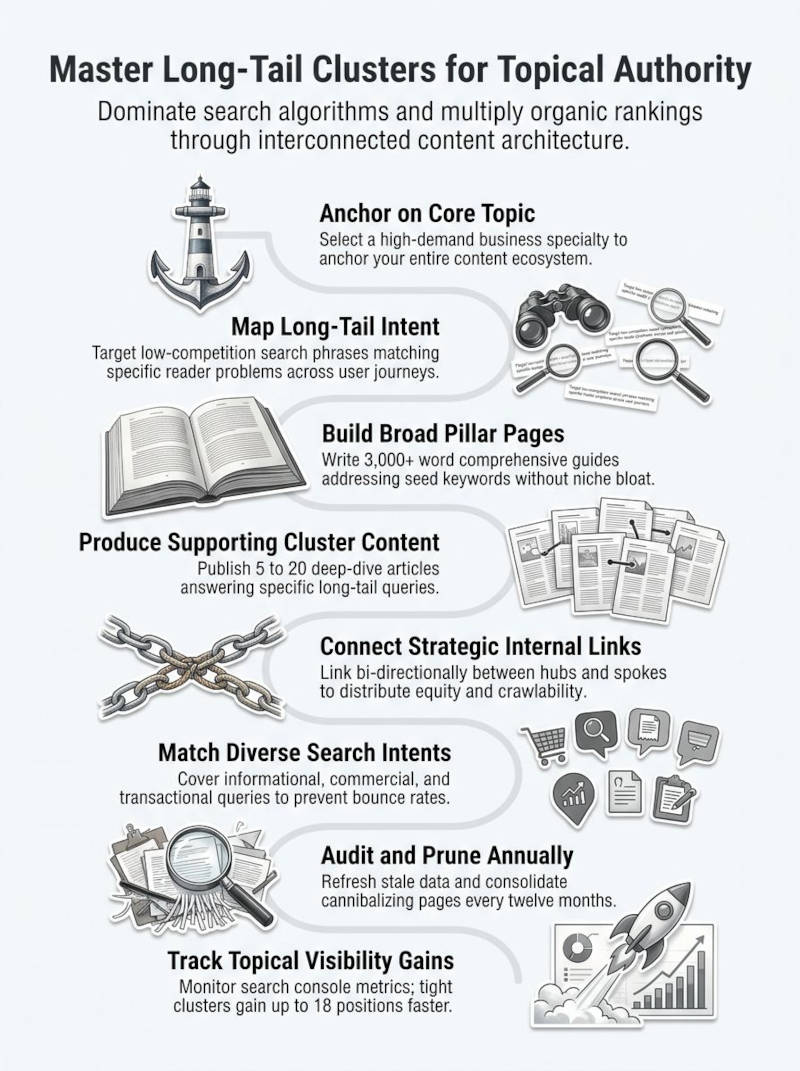
You create a long-tail content cluster by choosing a core topic tied to what you sell, collecting the real questions people ask about it, giving each search intent exactly one page, building the pillar and supporting pages, and linking them together. Then you measure the cluster as one unit.
1. Choose a Core Topic Tied to What You Sell
You should pick a topic for your cluster based on the service you would most like to sell. Each page in the cluster will then support your business. For example, if you are a Stamford roofer, you could use roof replacement as your main topic. A law firm may be best suited with personal injury claims. If a subject does not relate to your services, chances are low the people who visit from it will become customers.
2. Collect the Real Long-tail Questions
Get long-tail questions from places that show what people are actually asking and not just what you think they’re asking:
- Google Search Console: the queries your site already appears for, including long questions with impressions but no clicks.
- People Also Ask boxes on the search results for your topic.
- Google Autocomplete and related searches.
- Customer calls, emails and sales conversations.
- Keyword tools such as Ahrefs, Semrush or Moz for search volume and difficulty.
When targeting local customers, create both the city or town version and the service-area version of each question. Our Query Expansion System (QES) maps those location-based variations.
3. Group Questions by Search Intent
Questions that share the same intent belong on one page, and questions with a different intent get their own page. “How much does a roof replacement cost” and “roof replacement price” share an intent, so they go together. “How long does a roof replacement take” is a different intent and gets its own page.
A quick way to check: search both phrases. If most of the same pages rank for both, Google treats them as one intent and they belong on one page. If the results look different, give each its own page.
4. Check for Cannibalization Before You Write
Before you put a question onto a new page, be sure there isn’t an existing page targeting it. If there is one, improve the current page rather than create competition with a duplicate. This is why our keyword mapping service assigns each keyword to just one page.
5. Build the Pillar Page
Your pillar page gives a general overview of the main subject and links to all of your supporting pages. Each subtopic gets its own small section that covers the basics, then links to the supporting page that goes into greater detail. The pillar should cover enough material to match the depth of the subject. Length alone is not a ranking factor; what matters most is that the content is complete and helpful.
6. Write Supporting Pages That Answer First
Each of your supporting pages should answer one specific question within the first couple of sentences. After that, add details, examples and steps. Phrase your headings the way people search for them. Keep one idea per paragraph. Your sections should stand on their own. Since Google and AI tools often pull out a single passage, a section that depends on the one above it is harder for them to use.
7. Link the Cluster Together
Link your supporting pages back to your pillar. Link your pillar to all of your supporting pages. Also link supporting pages that are related to each other when it helps the reader. Use descriptive anchor text. Google’s link best practices say good anchor text is descriptive, reasonably concise and relevant to both the source and destination pages, which makes navigation easier for people and helps Google understand the destination page.
How Do Content Clusters Build Topical Authority?
Content clusters build topical authority by covering a subject from many angles and connecting those pages, so search engines can see that your site understands the whole topic, not just one keyword. Each supporting page adds coverage, and the links show how the coverage fits together.
Google’s systems are built to understand meaning and how topics relate. Clusters help show how your content relates (the connections). When all of the answers related to a topic are on the same site and linked to a pillar page, they give Google a better understanding than one big page with no context or connections around it.
Also, a cluster should only cover topics relevant to your business. If a marketing firm builds clusters about recipes, they won’t relate to its marketing services. So keep all of your clusters directly tied to the services you sell. This is covered in more detail in our semantic SEO guide.
How Do Content Clusters Help You Show Up in AI Answers?
Content clusters help you show up in AI answers because they cover the many related questions an AI tool may look up behind a single prompt, giving it more of your pages to cite. That matters more now that ranking in the top 10 no longer decides most AI Overview citations.
In a March 2026 Ahrefs study of 863,000 keyword results and 4 million AI Overview URLs, about 38% of cited pages ranked in the organic top 10, down from about 76% in Ahrefs’ July 2025 analysis. The two studies weren’t measured the same way (the 2025 study counted only the top three citations in each AI Overview), so read the drop as a direction, not an exact before-and-after.
| Organic Ranking of the Cited Page | Share of AI Overview Citations (Ahrefs, March 2026) |
|---|---|
| Top 10 | 37.1% |
| Positions 11 to 100 | 26.2% |
| Not in the top 100 | 36.7% |
The bottom line is that by covering a subject more broadly in an organized format, you have more chances of being cited by AI tools than you would with a single page fighting for one ranking. Answer-first sections, consistent business facts and clear internal links also make your pages easier for those AI tools to use. Our AI search optimization services cover that side of the work.
How Do You Measure a Content Cluster’s Performance?
You measure a content cluster by tracking the cluster as one group of pages, not page by page, and watching whether it shows up for more searches and brings in leads over time.
| Metric | Where to Find It | What It Tells You |
|---|---|---|
| Impressions across all cluster URLs | Google Search Console, filtered by page | Whether Google shows the cluster for more searches over time |
| Number of queries each page appears for | Search Console, Queries tab for each page | Whether supporting pages are picking up long-tail variations |
| Queries with impressions but no clicks | Search Console, sorted by impressions | Questions you appear for but don’t answer well yet |
| Average position of the pillar’s main keyword | Search Console or a rank tracker | Whether the supporting pages are lifting the pillar |
| AI answer citations and mentions | An AI visibility tracker | Whether AI tools treat your site as a source on the topic |
| Leads from cluster pages | Your analytics and call tracking | Whether the traffic is turning into customers |
That third row is how we found the gap this page fills. Sort your Search Console queries by impressions and look for long questions with zero clicks. Each one is a candidate for a new supporting page.
What Are the Most Common Content Cluster Mistakes?
The most common content cluster mistakes are pages that overlap, pages with no links, pages that miss what the searcher wants and clusters that drift away from what the business sells.
- Overlapping pages. Two pages answering the same question compete with each other. Merge them into one stronger page and redirect the other.
- Orphan pages. A supporting page with no links to or from the pillar looks like an island. Link every page into the cluster.
- Intent mismatch. Someone searching “how to fix a leaky faucet” wants steps, not a product list. Check what the search results actually show before you write.
- Off-topic clusters. Topics that don’t connect to your services bring visitors who never become customers.
- Set-and-forget content. Facts, prices and tools change. Review each cluster at least once a year and update anything out of date.
Conclusion
Long-tail content clusters turn scattered articles into one connected resource: a pillar page for the core topic, supporting pages that each answer one real long-tail question and links that tie them together. Most searches live in the long tail, and AI answers increasingly pull from pages beyond the top 10, so complete, well-linked coverage of the topics you sell is one of the most reliable ways to grow. Learn how we plan and build clusters on our topical authority SEO services page, or see how clusters fit a wider plan in our content marketing strategy guide.
Want to know which questions you’re missing? Request a free SEO4GEO audit from Gadgetlesstech in Stamford, CT. It compares your business with your top three Google Maps competitors across seven pillars and shows you what to fix first.
Frequently Asked Questions
- About the Author
- Latest Posts

Kevin Rhodes is the founder and lead of Gadgetlesstech, a digital marketing and SEO agency based in Stamford, Connecticut. He started Gadgetlesstech in 2010 as a consumer electronics e-commerce venture, then transitioned in 2014 toward web development and full-service digital marketing.
Today, under his leadership, the company helps businesses grow through search engine optimization, content marketing, custom web design (especially WordPress), and strategic digital marketing campaigns. Kevin is known for a hands-on approach to SEO and marketing strategy, and for building online visibility and lead generation for his clients.