
What Are BOFU Keywords (Bottom of Funnel Keywords)?
BOFU keywords (bottom of funnel keywords) are the search terms people use when they’ve reached the bottom of the sales cycle and are about to become a customer. Businesses target these keywords to turn ready-to-buy searchers into actual customers, because the people typing them are already planning a purchase.
Have you ever seen your website traffic climb while sales stayed flat? Many business owners run into this more often than they’d expect.
In our work with small and medium-sized businesses since 2010, the same pattern shows up again and again when we study buyer intent and search behavior: businesses chase the wrong type of keyword for the stage their buyer is in.
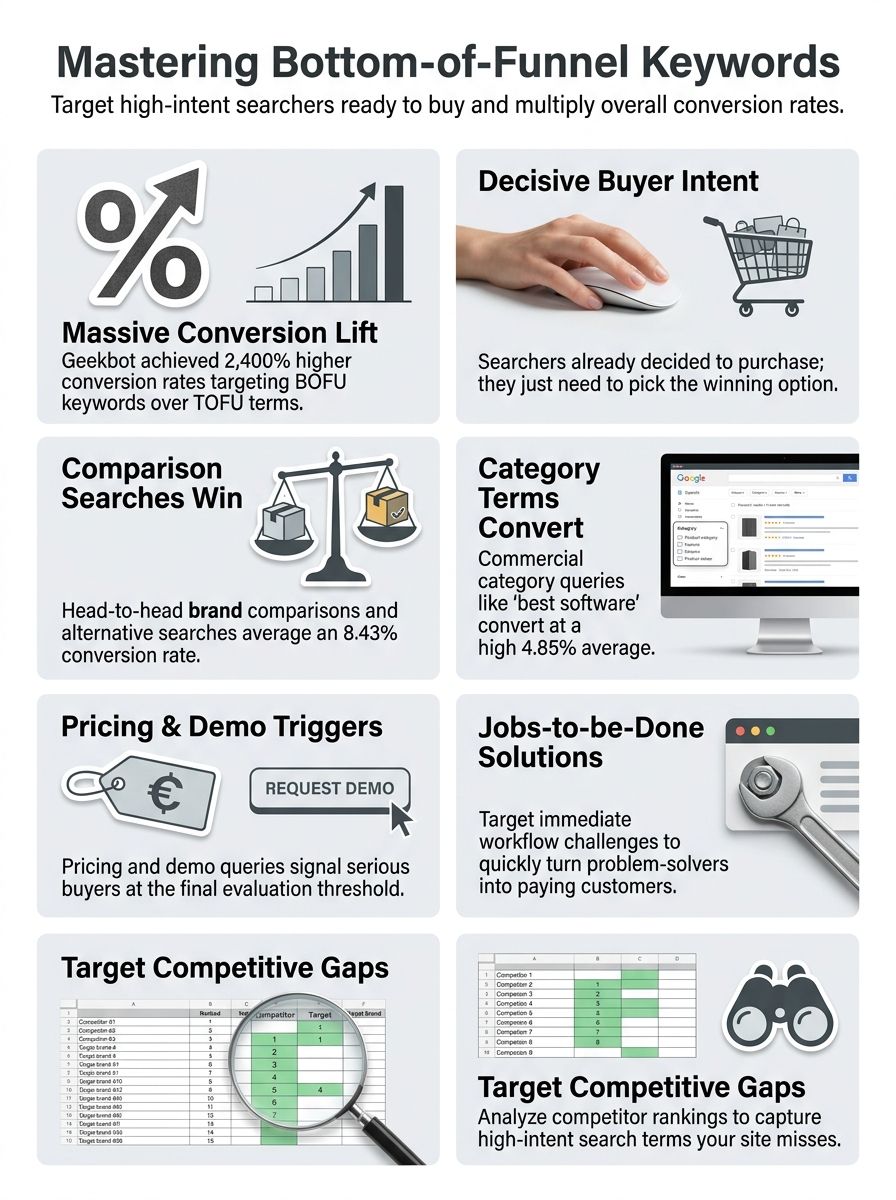
The fix we share most often is to match each keyword to where the buyer is right now. Geekbot did exactly that with its content agency, Grow and Convert. Its bottom of funnel articles converted at 4.78%, against 0.19% for top of funnel articles, roughly 25 times higher.
Below, we walk through what BOFU keywords are, how to find them, what they look like for local service businesses, and how to turn them into sales one step at a time.
Key Takeaways
- BOFU keywords target prospects who are ready to buy. In the Geekbot case study, BOFU articles converted about 25 times better than top of funnel articles (4.78% vs. 0.19%).
- BOFU keywords come in three types: category terms, comparison and alternative phrases, and jobs-to-be-done queries. Each one signals that the searcher is close to a decision.
- In Grow and Convert’s 2023 analysis, comparison and alternative keywords converted at an average of 8.43% and main category keywords at 4.85%, both far above top of funnel content.
- For local service businesses, BOFU keywords look like a service plus a town, a cost, or an urgency word, such as “emergency roof repair” or “roof replacement cost.”
- Comparison and “best” searches are no longer safe from AI Overviews. A 2026 Semrush study found AI Overviews on 88% of 400 tracked commercial keywords, so BOFU pages now need quotable, first-hand facts.
Defining BOFU (Bottom of Funnel) Keywords

BOFU keywords sit at the end of the buyer’s purchasing process. These high-intent keywords separate buyers who intend to purchase from browsers who are still curious.
That distinction drives every effective keyword strategy. BOFU keywords are always our first focus when we build a keyword plan, because they are the searches closest to a conversion.
What are BOFU keywords and how do they differ from TOFU and MOFU keywords?
A BOFU keyword is a search term from someone who intends to buy. TOFU and MOFU keywords come from people who have spotted a problem but are still learning about it or comparing possible solutions.
The purchase funnel has three stages. Each stage has its own type of keywords and its own conversion potential.
| Funnel Stage | What the Searcher Wants | Typical Keyword Signals | Conversion Potential |
|---|---|---|---|
| TOFU (top of the funnel) | General information about a problem | Broad questions and “what is” searches | Lowest conversion rates |
| MOFU (middle of the funnel) | Ways to weigh possible solutions | Words like “best” or “benefits” | Smaller, more qualified audience |
| BOFU (bottom of the funnel) | The right product or provider to buy from now | Brand names, “vs,” pricing, demo, “near me” | Highest conversion rates |
TOFU keywords cover general questions about a problem a person may be facing. MOFU keywords get more specific, often using words like “best” or “benefits,” because the searcher is weighing which solution fits their needs.
Bottom of the funnel keywords are the most targeted searches of the three. The searcher has finished their research and evaluation, which is why these searches convert at the highest rates.
Examples of buying-intent keywords include “ABC vs XYZ project management software” or “roof replacement cost Connecticut.” BOFU searches also include branded searches and product-specific terms, which signal that a user has reached the final stage of the buying journey.
Where do comparison terms fit in the funnel?
Comparison terms sit right on the line between MOFU and BOFU. Many content teams put broad comparisons and alternatives in MOFU and save BOFU for product features and pricing details.
Our rule of thumb: if the searcher compares two or more products or services by brand name, they are trying to pick a winner, not still learning. That makes the search BOFU.
Many BOFU keywords are long-tail keywords, meaning longer and more specific searches. Long-tail keywords get fewer monthly searches than short, generic ones, but their higher conversion rates make up for the smaller numbers.
Your own analytics will usually show the same split. In Google Analytics 4, compare conversion rate by landing page, and you’ll typically find a handful of decision-stage pages producing most of the leads while broad informational posts bring traffic and few conversions.
The most profitable keywords are those closest to the purchase decision, where intent turns into action.
The Importance of BOFU Keywords
BOFU keywords matter because they reach people who are ready to buy now. When someone searches for a product comparison, a price, or a provider for a specific job, they have already moved past the awareness stage.
They know exactly what problem they’re trying to solve, and they want the answer fast.
Several groups get the most out of BOFU keywords:
- Lead generation teams: BOFU terms bring qualified prospects to landing pages, not just curious browsers.
- Google Ads campaigns: Ads tend to perform better when the searcher’s intent lines up with what you sell.
- B2B SaaS companies: The sales funnel narrows at the bottom, and BOFU keywords reach prospects at that key moment.
- Local service businesses: Searches like “emergency roof repair” or “same day AC repair” come from people who need someone this week.
Someone who searches “Shopify vs. WooCommerce” isn’t casually browsing. They’re making an active decision.
When you show up at that moment with a clear call to action (CTA), your chances of turning the visit into revenue go up. A CTA is simply a button, link, or request asking your visitor to take the next step, like “Start free trial” or “Get a free estimate.”
Why are BOFU keywords critical in the sales funnel?
BOFU keywords are critical because they reach the smallest but most profitable group of searchers: people ready to make a purchasing decision. Those searchers convert at much higher rates than visitors at any other stage.
The clearest public data comes from Grow and Convert’s Geekbot case study, which covers about two years of work starting in March 2020. Bottom of funnel articles converted at 4.78%, and top of funnel articles converted at 0.19%. That is roughly 25 times higher, which Grow and Convert describes as a 2,400% higher conversion rate.
| Geekbot Metric (About 2 Years) | BOFU Articles | TOFU Articles |
|---|---|---|
| Articles published | 22 of 64 (34.4%) | 42 of 64 (65.6%) |
| Conversions (trials) | 1,348 (77.24% of all conversions) | 397 (22.76%) |
| Organic traffic | 28,190 | 204,303 |
| Conversion rate | 4.78% | 0.19% |
The TOFU articles drew about 7 times more organic traffic but produced only 397 conversions. That trade-off is the real lesson: a small set of BOFU pages can drive most of your conversions, even with far less traffic.
That’s why we build content strategy around high-intent traffic first. We concentrate on comparison and alternative keywords, category keywords, and jobs-to-be-done keywords that name the searcher’s pain point.
Content in the middle stages still feeds BOFU conversions. The marketing funnel works as one process, and every stage feeds the final one, where prospects become customers.
For lead generation, the bottom of the funnel is where your strongest call to action belongs, because that is where the sale happens.
Optimizing for BOFU keywords raises conversion rates (in Geekbot’s case, about 25 times over top of funnel content) and raises the value of every organic visit, because the search term matches real purchase intent.
Key Characteristics of BOFU Keywords
BOFU keywords carry clear signs of purchase intent. They are highly targeted, highly specific, and focused on solving a problem the searcher already has.
These searches sit in the “checkout lane” of a prospect’s buying process. The sections below cover how to tell BOFU searches apart from everything else.
How do BOFU keywords reflect high purchase intent?
BOFU keywords reflect high purchase intent because the searcher has already decided to buy and is using the search to choose which product or provider to buy from.
People searching BOFU keywords are well informed. They have usually researched and compared several options before this final search.
Common signs of strong purchase intent include:
- Branded terms and direct product names
- Product comparisons, such as “ABC vs XYZ software”
- Pricing and cost questions, and words like “buy,” “quote,” or “estimate”
- Demo or consultation requests
Grow and Convert’s 2023 analysis of conversion rates by keyword type found that comparison and alternative keywords converted at an average of 8.43%, the highest of any type it measured.
Main category keywords, like “mens running shoes,” averaged a 4.85% conversion rate in the same Grow and Convert analysis. That is lower than comparison terms, but it still reflects strong purchase intent.
BOFU keywords usually get fewer searches than earlier-stage keywords, but each search is worth more to a business, because each searcher is a potential paying customer.
That is why software companies, e-commerce stores, financial services firms, and local service businesses all prioritize BOFU keywords. They use keyword research tools to find the high-intent terms, then build landing pages and CTAs around them.
BOFU searchers are comparing pages to see which one answers their final question fastest. A good BOFU page cuts right to the comparison or the price and clearly shows the visitor what to do next. Anything that slows the buying process down, like a long introduction or a buried contact form, can cost you the sale.
The searcher at the bottom of the funnel has already decided to buy; they’re simply choosing between options.
Why are BOFU keywords specific and targeted?
BOFU keywords are specific because the searcher is looking for exactly what they want to buy, not just learning about a topic. They already know a solution exists, and they need the right one.
Someone searching “Salesforce alternative” does not need to learn what customer relationship management (CRM) software does. They have done their research and are now comparing options.
BOFU searches tend to include details like these:
- Brand names
- Product models
- Specific product features
- Named competitors
- A town, region, or “near me”
That level of detail keeps the search focused on buying rather than exploring, and it separates serious buyers from browsers.
Because these keywords clearly signal a purchase, Google Ads competition for them is usually high. Content built for BOFU keywords should give definitive answers to the last questions that keep the buyer from deciding. At this stage, the reader doesn’t need an introduction to the basics.
Jobs-to-be-done keywords show this precision most sharply. They name the actual task the product or service solves, not just the category.
For example, a homeowner searching “roof leaking around chimney” needs a different page than someone researching roofing materials in general. That precision lets you build the page around the searcher’s exact problem.
Comparison and alternative keywords work the same way. Both show searchers at the end of their research, weighing the pros and cons of each option before they buy.
In short, the precision of BOFU keywords turns instructional content into sales content.
How do AI Overviews affect BOFU keywords?
AI Overviews now appear on most comparison, alternative, and “best X for Y” searches, so those BOFU keywords can lose clicks to Google’s AI summary. Transactional searches, where someone is ready to act right now, are less exposed. AI Overviews are the AI-generated summaries Google shows above the regular results.
The shift happened fast. In Semrush’s 12-month study of 400 commercial keywords across banking, software, and e-commerce, AI Overview coverage rose from 45.75% in September 2025 to 88% in August 2026 (U.S. desktop data).
| Keyword Group (Semrush Panel) | AI Overview Coverage, Sept 2025 | AI Overview Coverage, Aug 2026 |
|---|---|---|
| All 400 commercial keywords | 45.75% | 88% |
| “Best X for Y” | 42.72% | 96.12% |
| “Alternatives” | 48.44% | 82.81% |
| “Price/cost” | 43.59% | 82.05% |
Transactional searches tell a different story. In an earlier Semrush analysis of more than 600,000 keywords from November 2025 to April 2026, the share of commercial-intent results with an AI Overview grew 71%, while the share of transactional results with an AI Overview fell 5%.
Clicks are the cost. Seer Interactive’s September 2025 study of 3,119 informational queries across 42 organizations measured organic click-through rate (CTR) at 0.61% on queries with an AI Overview, against 1.62% on queries without one. Seer’s 2026 update found CTR on AI Overview queries recovering in early 2026, so the impact is real but still shifting.
In practice, this splits BOFU strategy in two. For comparison and alternative keywords, plan to be cited inside the AI Overview, not just ranked below it. That means quotable facts, honest trade-offs, and first-hand detail on the page. For transactional and local keywords, a strong service page that answers the search quickly is still the cleanest path to the click and the call.
Review your BOFU terms to see which ones trigger an AI Overview, and track them over time. Generative engine optimization (GEO), which means shaping your content so AI tools cite it, is now part of the same SEO plan.
How do BOFU keywords influence decision-making?
BOFU keywords influence decisions by putting your solution in front of buyers at the moment they are most ready to act. Calls to action like “buy now,” “get a demo,” or “request an estimate” then help convert them.
Several forms of content help close the sale:
- Product demos and tutorials show the product doing the job.
- Comparison charts give buyers the facts they need to justify a purchase.
- Calculators and cost estimators help prospects confirm their choice before they commit.
- Reviews, case studies, and before-and-after photos add social proof and credibility.
BOFU keywords mark the last stop before conversion on most buyer journeys. Comparison and alternative keywords help the buyer weigh competing options during this final phase, which is why they are so powerful at this step.
Good BOFU content builds trust by answering the buyer’s specific objections. Search engine optimization puts that content in front of high-intent searchers at the right time, while they are comparing products or providers.
BOFU keywords are where buyers move from research mode into purchase mode, which makes them the most valuable touchpoints for any site that wants to turn visitors into customers.
Common Types of BOFU Keywords
BOFU keywords fall into three types: category, comparison and alternative, and jobs-to-be-done. Some marketers split comparison and alternative keywords apart, which gives four.
Category keywords name what a business sells, such as “best accounting software.” Comparison and alternative keywords set two or more named options against each other, such as “Salesforce vs. Pipedrive” or “Salesforce alternative.” Jobs-to-be-done keywords name the task a buyer needs done, such as “how to do a poll in Slack.”
Grow and Convert uses the same three buckets in its Pain Point SEO framework. Here’s a closer look at each one.
What are category keywords in BOFU?
Category keywords state exactly what products or services a business offers, such as “best accounting software” or “mens running shoes.” The searcher already knows the type of product or service they want, so all they need to find is the right seller.
That is why category keywords carry high purchase intent. The searcher is simply choosing who will provide the product or service.
SEO professionals go after these terms hard because they convert well, like the 4.85% average Grow and Convert measured for main category keywords. Google Ads bidding wars over category keywords happen for the same reason.
Expect these traits with category keywords:
- Higher search volume than most other BOFU terms
- High intent tied directly to core products or services
- Heavy competition from established brands
- Large PPC (pay-per-click) budgets from rivals
Ranking for category keywords can drive significant sales increases. Because these results are so competitive, many businesses also spend heavily on PPC to capture a share of these ready-to-buy customers.
When a user searches “best project management tool,” the call to action is obvious. To win a share of those customers, most businesses need both organic SEO and paid advertising.
How do comparison and alternative keywords work for BOFU?
Comparison and alternative keywords identify searchers in the final stage of their purchase decision. Phrases such as “Salesforce vs. Pipedrive” or “Salesforce alternative” show a buyer choosing among competitors.
These searches converted at an 8.43% average in Grow and Convert’s 2023 data, the best of any keyword type. Smaller brands can use this by writing honest comparison content and competing head to head with bigger players.
These searchers want fair, specific information before they buy. Content for these keywords usually includes:
- Side-by-side feature breakdowns
- Pros and cons lists
- Direct competitor analysis
- Specific pain points and differences between options
Searchers using comparison or alternative keywords know their options well and are close to a final choice, which makes them very valuable prospects.
Alternative keywords link product discovery and purchase. Whether an alternative term is less competitive than a broad category term depends on the market, so check a keyword’s difficulty score before assuming it is an easier win.
Someone searching alternatives has already chosen a type of solution and wants to see other options before committing.
That makes the call to action much more compelling at this stage. The searcher already understands the category, the problem, and the solutions available.
What are jobs-to-be-done keywords and how do they apply to BOFU?
Jobs-to-be-done keywords name the task a product or service actually solves, such as “how to organize design files” or “roof leaking around chimney.” They identify people with an immediate problem they need resolved.
Buyers using jobs-to-be-done keywords may not be researching a particular brand yet, but they are actively looking for a fix to a problem they have today.
Jobs-to-be-done keywords sit in the middle to bottom of the funnel, where purchase intent grows stronger. They reveal intent even when the searcher never mentions a competitor or a product category.
In many cases, the buyer doesn’t even know your brand name. If your product or service solves their problem, they will be ready to buy anyway.
Here’s how we apply jobs-to-be-done keywords to a BOFU strategy:
- Pick a real task your product or service handles, like “how to do a poll in Slack” or “fix a leaking skylight.”
- Answer the question fast, since the searcher isn’t asking for reviews or comparisons.
- Show exactly how your tool or team handles that task.
- Add a clear CTA that turns the problem-solver into a customer.
Jobs-to-be-done keywords work as bridge terms. Once the searcher finds your business through one and sees that you solve their problem, they move down the funnel toward a purchase.
Jobs-to-be-done keywords let a business reach high-intent buyers who may not know any competitor brands but are ready to buy once their problem is addressed.
Strategies to Identify BOFU Keywords
BOFU keywords are easiest to find with a mix of brainstorming, SERP research, and keyword tools. Together, they show what buyers search once they’ve made up their minds.
Each method works on its own, but combining them gives you the most complete list.
How can you brainstorm relevant BOFU keyword categories?
Brainstorm BOFU keyword categories using the actual words your customers use when they talk about your product or service. Then collect buying language from several places.
Begin with the people closest to your buyers:
- Examine customer feedback and support questions for decision-stage language that shows up again and again.
- Ask your sales team, or whoever answers the phone, how prospects describe the problems they want solved. Those phrases turn straight into BOFU keyword categories.
- Read testimonials and reviews for natural BOFU keywords. They show how real buyers describe their evaluation and purchase.
- Browse industry forums and question-and-answer sites. They reveal the exact phrases buyers use when they’re ready to choose.
Next, map your product and your market:
- List every way customers refer to your product category and direct competitors. This builds the base for your category keywords.
- Analyze your features, benefits, and selling points to spark keyword ideas that match what prospects search at the decision stage.
- Write down every term that implies readiness to buy or direct comparison with competitors. These become your comparison and alternative keywords.
- Brainstorm jobs-to-be-done keywords by listing the outcomes your product or service delivers.
- If you serve a local area, list every town, county, and neighborhood you work in. Pair each with your core services to build your local BOFU list.
How do you research comparison and alternative BOFU terms?
Research comparison and alternative BOFU terms by studying the search engine results pages (SERPs) and the pages that already rank there. SERPs show exactly what prospects search when they’re ready to buy.
Start inside Google’s own results:
- Search “alternative” and “vs” with competitor names to see what searchers actually compare. These searches signal high purchase intent and reveal your direct competition.
- Study the titles in the SERP to find the most natural phrasing. Strong titles show how winning pages frame their comparison content.
- Use Google’s “People Also Ask” section to find related comparison questions and subtopics. It reveals the side worries buyers have while they decide.
- Check related searches at the bottom of the SERP. They often include long-tail variations you missed at first.
- Use Google’s autocomplete suggestions to find long-tail versions of comparison queries (a simple form of query expansion). These suggestions capture specific product pairings and niche comparisons your audience cares about.
Then look beyond the search results:
- Monitor user-generated content, such as review forums and comparison sites, for new keyword trends. Real conversations show the language prospects use when they evaluate options.
- Look at how competitors structure their comparison content. Their approach shows you gaps and positioning chances for your own pages.
- Update your list regularly as new competitors or industry terms appear, so your pages and CTAs stay current.
What are the best keyword research tools for finding BOFU keywords?
The best tools for finding BOFU keywords are Ahrefs, SEMrush, Clearscope, Moz Keyword Explorer, and Google Search Console. Each one has its own strength for discovering high-intent search terms.
| Tool Name | Key Features for BOFU Keywords | Best Used For |
|---|---|---|
| Ahrefs | Content Gap tool identifies organic keywords competitors rank for but your site does not. Long-tail keyword variations surface through the keyword explorer feature. Search volume and difficulty metrics guide targeting decisions. | Competitive analysis and discovering missed BOFU opportunities |
| SEMrush | Keyword research features reveal comparison and alternative terms customers use. Search intent labels highlight commercial and transactional searches. Related keyword suggestions expand BOFU term coverage. | Identifying comparison keywords and purchase-focused search queries |
| Query Expansion System | Semantic analysis highlights related terms that boost content relevance. Contextual keyword suggestions align content with actual search intent. | Optimizing content for semantic relevance and search intent |
| Moz Keyword Explorer | Keyword suggestions include search volume and difficulty scores. Organic CTR estimates show which BOFU terms are likely to earn clicks. Priority scoring ranks keywords by value and opportunity. | Prioritizing BOFU keywords by search volume and ranking difficulty |
| Google Search Console | Existing BOFU queries that drive traffic appear in the performance report. Click-through rate data shows which queries earn clicks. Performance trends reveal seasonal BOFU keyword patterns. | Finding proven BOFU keywords already bringing in visitors |
Each tool earns its spot in a different way. Here’s how we use each one:
- Ahrefs for competitor gaps: The Content Gap tool shows keywords your competitors rank for while your site stays invisible. That gap often hides valuable BOFU terms with proven demand. The keyword explorer adds long-tail variations, and the volume and difficulty numbers help you choose what’s worth chasing.
- SEMrush for comparison terms: SEMrush is great at surfacing comparison and alternative keywords. Searches like “X vs Y” or “X alternatives” show clear purchase intent, and related keyword suggestions grow your BOFU list so you don’t miss key variations.
- Clearscope for related terms: Clearscope focuses on semantic relationships, meaning the related words and ideas around a topic. It shows which terms to include next to your main BOFU keywords, right in the editor.
- Moz Keyword Explorer for priorities: Search volume tells you how many people search each term per month, and difficulty scores show how hard ranking will be. Priority scoring blends these numbers to rank each opportunity by value.
- Google Search Console for proof: Search Console shows how your site is really doing. Queries that already send visitors appear in the performance report, and click-through rates show which BOFU keywords earn the click.
Use these tools together for full BOFU keyword coverage, since each one fills gaps the others leave. Ahrefs compares your content against competitors, SEMrush surfaces comparison terms, Clearscope checks related terms, Moz helps you sort by volume and difficulty, and Search Console confirms real-world results.
What is a step-by-step process to find effective BOFU keywords?
The BOFU keyword process has 4 basic moves: brainstorm, check, filter, and prioritize. Start with category, comparison, and jobs-to-be-done ideas, check each one in Google and a keyword tool, filter by buying modifiers and competitor gaps, then rank what’s left by intent, conversion potential, and competition.
Here’s the full version, broken into steps you can follow today.
Build your list:
- Brainstorm category, comparison, and jobs-to-be-done keywords relevant to your business. This step gives you the raw material for deeper research.
- Check the SERP for each candidate keyword. Note what kind of pages rank and what phrasing appears in titles, since that shows real search intent.
- Use tools like Ahrefs or SEMrush to check search volume and find more variations and long-tail keywords.
- Use Google’s “People Also Ask” section to find related questions and subtopics you might miss.
Refine and prioritize:
- Filter keywords by buying modifiers such as “software,” “service,” “cost,” or “near me.” Adding these modifiers narrows your list to searchers who are ready to buy. Use the full modifier list in the table below.
- Run a content gap analysis to find BOFU keywords your competitors rank for and you don’t. This often reveals easy wins in your niche.
- Review your published content for BOFU keywords that rank just below page one. Some of your best chances may already be sitting on your site.
- Prioritize keywords by search intent, conversion potential, and competition, then give each one its own page through keyword mapping so no two pages compete for the same search.
BOFU modifiers group into a few families. Use them to filter your keyword exports in Ahrefs or Semrush.
| Modifier Family | Example Modifiers |
|---|---|
| Category | tool, app, software, platform, service, company |
| Industry or persona | “X for [industry],” “X for [persona]” |
| Comparison | vs, alternatives, competitors |
| Reviews | reviews, pros, cons, top-rated |
| Pricing and cost | price, cost, quote, estimate, discount, free |
| Leaders | top, best |
| Local and urgency | near me, [town or county], emergency, same day, open now |
Examples of Effective BOFU Keywords
BOFU keywords are easier to spot once you see real ones in action. Below are product-specific terms, comparison phrases, and local service searches that match buyers who are ready to make their move.
Use these as templates for your own brand, services, and competitors.
What are examples of product-specific BOFU keywords?
Product-specific BOFU keywords name a brand, model, price, demo, or feature, such as “pricing for HubSpot CRM” or “demo of QuickBooks.” They are among the strongest BOFU keywords because the searcher has already narrowed their choices to a specific product.
| Product-Specific Term Type | Real-World Example | Why This Matters | Conversion Signal |
|---|---|---|---|
| Brand + Model Keywords | “Buy Salesforce CRM online” | Attracts searchers who know exactly what solution they want | High-intent, product-specific keyword with strong conversion potential |
| Comparison Keywords | “ABC vs XYZ project management software” | Searchers evaluate two specific solutions side by side | Indicates comparison and purchase intent from ready buyers |
| Pricing Keywords | “Pricing for HubSpot CRM” | Directly addresses a key decision factor for ready-to-buy customers | Cost concerns signal the final evaluation phase |
| Demo Keywords | “Demo of QuickBooks accounting software” | Used by those seeking a final evaluation before purchase | Indicates an imminent buying decision |
| Feature Keywords | “Features of Slack workspace app” | Addresses users looking to confirm product capabilities | Searcher validates fit for their specific needs |
| Category + Qualifier Keywords | “Best accounting software for small businesses” | Targets users ready to evaluate specific solutions | Combines category intent with readiness to decide |
Brand names, model numbers, and SKU codes turn generic searches into sharp buying signals. Product-specific terms are among the strongest converters in search, though comparison and alternative terms still hold the top average in the data above, at 8.43%.
When buyers use product-specific terms, they have already limited their options. Each term type tells you something slightly different:
- “Buy [product name] online”: These phrases combine intent with action. The searcher has moved past research and into purchase mode, so answer fast.
- “Pricing for [brand/model]”: Pricing queries reveal serious shoppers comparing cost against budget. Put clear prices and plan details up front.
- “Demo of [product name]”: Demo requests signal final evaluation. These prospects have usually checked out competitors and now want to see if the product fits their workflow.
- “Features of [product name]”: Feature searches show buyers looking for reassurance that the tool solves their specific problems.
- “Best [category] for [audience]”: Phrases like “best accounting software for small businesses” capture category interest plus a clear target. Local services work the same way: someone searching for a local SEO company in Connecticut wants a provider, not a lesson.
Product-specific BOFU keywords beat generic terms because the words themselves show exactly what the buyer wants and how ready they are. The searcher has decided to buy and is simply picking the right product.
Why do “best” and comparison phrases convert at the bottom of the funnel?
“Best” and comparison phrases convert at the bottom of the funnel because the searcher has finished most of their research and is looking for the final push, or the final validation, before they buy.
| Comparative Phrase Type | Real-World Example | Why It Works at BOFU |
|---|---|---|
| “Best [product/service] for [audience/industry]” | Best project management software for remote teams | This phrase targets people who already know what they want and are looking for the version that fits their situation. |
| “Top [number] [products/services] 2026” | Top 5 CRM platforms 2026 | Searchers compare leading options before buying and want current information about market leaders. |
| “[Brand A] vs [Brand B]” | HubSpot vs Salesforce, Shopify vs WooCommerce | Direct head-to-head comparisons address users weighing competing solutions. Comparison terms carry the highest average conversion rate in the data above. |
| “[Brand] alternative” | Asana alternative, Monday.com alternative | Buyers searching for alternatives may have already ruled out one option. Many are ready to switch. |
| “Best [category] with [specific feature]” | Best email marketing software with AI automation | Feature-focused searches reveal what matters most to buyers, which attracts serious decision-makers. |
| “Top-rated [product/service]” | Top-rated web hosting providers, top-rated roofers in Fairfield County | Social proof shapes final purchase decisions. These terms tap into trust signals. |
| “Compare [product] plans” | Compare Slack pricing plans, compare Adobe Creative Cloud tiers | Users searching this way have narrowed choices to one brand and are comparing tiers, very close to a purchase. |
| “Best value [category]” | Best value accounting software, best value web design tools | Budget-conscious buyers want the best mix of price and performance. |
Comparative terms line up with the last step in the buying process, so they tend to produce more clicks and conversions than general terms.
When buyers search for the “best” option, they have usually done most of their research, narrowed their choices, and want confirmation for the choice they are leaning toward.
Brands benefit from capturing both directions of comparison searches. “Brand A vs Brand B” queries bring in shoppers evaluating competitors, and “[Brand] alternative” searches bring in people thinking about switching.
These are also the BOFU searches most likely to show an AI Overview. In Semrush’s 2026 panel, “best X for Y” searches reached 96.12% AI Overview coverage, so your “vs” and “best” pages need original, hands-on details to earn citations and clicks.
Keep year modifiers current. A “2024” in a 2026 title tells readers and search engines the page is stale.
What do BOFU keywords look like for local service businesses?
For a local service business, BOFU keywords pair a specific service with a place, a price, or an urgency word, such as “roof replacement cost Connecticut” or “emergency roof repair.” The searcher already knows what job they need done and is choosing who to call.
Local buyers rarely type brand-versus-brand comparisons. They type the job, the place, and how soon they need it. A homeowner with water coming through the ceiling doesn’t research roofing materials first. They search for someone who can come out this week, check the reviews, and call. A page built for that searcher needs the service, the area served, proof of real work, and a phone number near the top.
| Local BOFU Pattern | Example Search | What the Searcher Wants |
|---|---|---|
| Service + town | “roof repair Greenwich CT” | A provider who works in their area |
| Urgency | “emergency roof repair,” “same day AC repair” | Help today or this week |
| Cost | “roof replacement cost Connecticut” | A realistic price range before they call |
| Near me | “roofer near me” | The closest trusted option |
| Best or reviews | “best roofer in Fairfield County” | Proof that a provider is reliable |
| Problem (jobs-to-be-done) | “roof leaking around chimney” | A fix, which usually means a repair visit |
We used this approach for an anonymized roofing contractor in southwestern Connecticut. Each service (inspection, repair, replacement, storm damage, flat roofing, and more) got its own page aimed at one compact BOFU keyword, with no two pages competing for the same search. Between May and October 2026, estimated organic traffic rose 123%, page-one rankings grew from 4 to 6 keywords, and the site earned its first #1 Google position, based on DataForSEO estimates. The full breakdown is in our roofing contractor SEO case study.
Local BOFU keywords also face less AI Overview pressure than SaaS comparisons. In the same Semrush analysis that found commercial-intent AI Overviews up 71%, the share of transactional results with an AI Overview fell 5%, and one of Semrush’s own transactional examples was a local “near me” search. That keeps the classic service page and Google Business Profile in play for local buyers.
How Do You Rank Pages for BOFU Keywords?
You rank pages for BOFU keywords by building a page that matches the search intent exactly and answers the buyer’s last concerns about taking the next step. The best BOFU pages back up their claims with real prices, real comparisons, and real proof.
The BOFU page ranking checklist starts with one page per keyword, with that keyword in the title, headline, and URL, in a format that matches what already ranks in the SERP. Next, add honest comparisons, clear pricing, original screenshots or data, and answers to the “People Also Ask” questions. Finally, add internal links from related TOFU and MOFU posts to build the page’s authority, a clear CTA near the top, and regular updates to dates, prices, and competitor details.
Before you publish, run through these quick checks:
- Does the page answer the search in the first few lines?
- Would a buyer find the price, a demo option, a free trial, or a phone number without scrolling far?
- Are competitor details fair and up to date?
- Is the year in the title current?
- Does the page include at least one fact an AI Overview could quote and credit to you?
What content formats and CTAs work best for BOFU intent?
Comparison pages, alternatives pages, pricing pages, demo pages, and service-plus-location pages work best for BOFU intent. Pair them with direct CTAs like “Book a demo,” “Start free trial,” or “Get a free estimate.”
Here’s how each format lines up with a keyword type and a CTA.
| Content Format | Best Keyword Match | CTA Example |
|---|---|---|
| Comparison page | “[Brand A] vs [Brand B]” | “See how we compare” or “Start free trial” |
| Alternatives page | “[Brand] alternative” | “Switch today” or “Try it free” |
| Pricing page | “Pricing for [product],” “Compare [product] plans” | “Choose your plan” |
| Demo page | “Demo of [product]” | “Book a demo” |
| Service + location page | “[Service] [town],” “[service] near me” | “Call now” or “Get a free estimate” |
| Calculator or cost estimator | Category, cost, and jobs-to-be-done keywords | “Get your estimate” |
| How-to tutorial | Jobs-to-be-done keywords | “Try this in [product]” or “Book a repair” |
Keep one main CTA per page so the next step is obvious. A second, softer option, like “Talk to sales” or “See our reviews,” helps visitors who aren’t quite ready.
Turning Bottom of the Funnel Keywords Into Sales
Bottom of the funnel keywords are where search traffic turns into revenue. They may bring less traffic than other keywords, but the people arriving on these pages are looking to buy.
Start by finding the three forms of bottom of the funnel keywords (category, comparison and alternative, and jobs-to-be-done) through brainstorming, reviewing Google’s results, and using one or two keyword research tools. If you serve a local area, add your service-plus-town and cost searches to the list.
Next, build pages that answer the buyer’s last objections and make the next step easy.
This week, choose one BOFU keyword and build a page designed to earn the sale. Track its conversion rate against your informational posts, and let the numbers guide your next page.
Frequently Asked Questions
Getting Help With Your BOFU Keyword Strategy
Gadgetlesstech is a full-service digital marketing agency based in Stamford, Connecticut. Since its founding in 2010, the agency has helped small to medium-sized businesses grow their online presence, and our SEO services take a holistic approach to digital strategy.
The holistic approach means keywords, content, and conversion paths are built as one system, which is how we run our content marketing services. It works especially well for BOFU, since a keyword only produces value if the page and the CTA do their jobs.
We use our Query Expansion System to find the real buying-intent variations your customers search, then expand each one to find the similar searches around it.
| Detail | Gadgetlesstech |
|---|---|
| Location | 20 Summer Street, 4th Floor, Stamford, CT 06901 |
| Founded | 2010 |
| Company Size | 2 to 9 employees (boutique agency) |
| Pricing | Scoped to the work your market requires, not fixed packages. Local SEO campaigns typically run about $500 to $3,000+ per month (see our Local SEO pricing guide). |
| Client Rating | About 4.5 out of 5 on average across review platforms |
If you want your BOFU keywords mapped to pages that actually convert, Gadgetlesstech can build the keyword plan and the money pages behind it. To see where your bottom-of-funnel gaps are, book a strategy call.
- About the Author
- Latest Posts

Kevin Rhodes is the founder and lead of Gadgetlesstech, a digital marketing and SEO agency based in Stamford, Connecticut. He started Gadgetlesstech in 2010 as a consumer electronics e-commerce venture, then transitioned in 2014 toward web development and full-service digital marketing.
Today, under his leadership, the company helps businesses grow through search engine optimization, content marketing, custom web design (especially WordPress), and strategic digital marketing campaigns. Kevin is known for a hands-on approach to SEO and marketing strategy, and for building online visibility and lead generation for his clients.