What Google’s E-E-A-T Actually Means in 2026 (And What Changed This Year)
Most E-E-A-T guides repeat the same four words, offer the same generic author-bio advice, and never once include an actual date, a real document, or a real number. That’s the problem. If your content sounds exactly like every other page explaining E-E-A-T, you’ve proven the opposite of what you set out to prove.
This one is different on purpose. Here’s what E-E-A-T actually is, what Google changed in its rater guidelines this year, what two 2026 core updates actually rewarded, and why “more experience signals” isn’t automatically the fix people think it is.
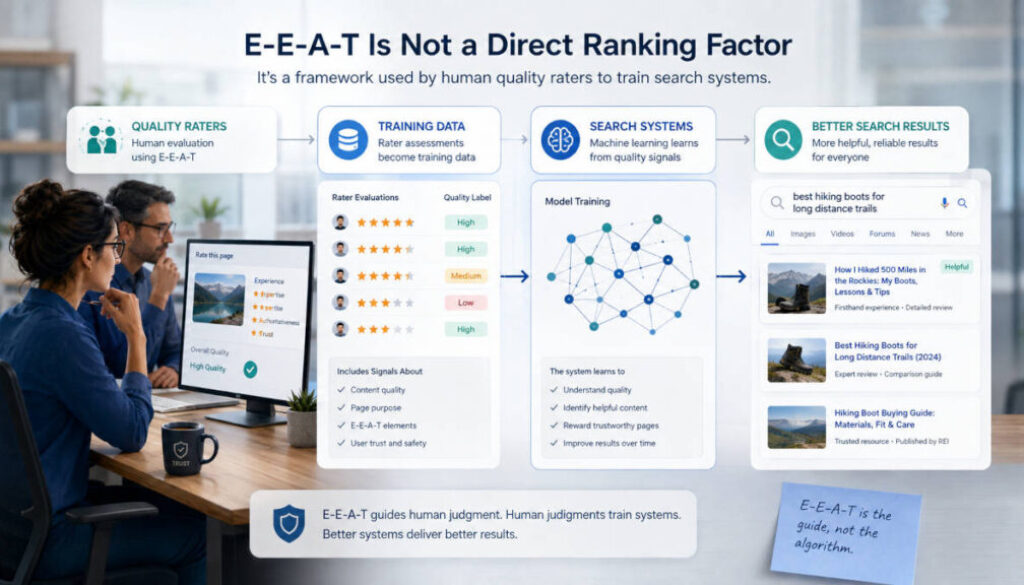
E-E-A-T is not a ranking factor. It’s an answer key for the people who train the algorithm.
Here’s the part most explainers get backwards: there is no E-E-A-T score sitting in Google’s ranking code. E-E-A-T lives inside the Search Quality Rater Guidelines, the manual Google gives to thousands of human contractors who manually score search results all day. Those raters don’t touch your rankings directly. Their scores become training data that Google’s machine learning systems use to learn what “good” looks like, at scale, across billions of pages.
So when someone says “improve your E-E-A-T,” what they actually mean is: make your page look, to a trained human evaluator, like the kind of page Google wants its algorithms to learn to reward. That distinction matters because it explains why E-E-A-T fixes (author bios, credentials, an About page) correlate with better rankings without being a lever you can pull directly.
The framework itself has a real history. Google introduced E-A-T (Experience wasn’t in it yet) back in 2014. Then, on December 15, 2022, Google added the second E for Experience, splitting what used to be one bucket (“Expertise”) into two: whether you have formal knowledge, and whether you have actually done the thing you’re writing about. That’s the update that turned E-A-T into E-E-A-T, and it’s the reason first-hand use, direct testing, and original photography now carry real weight that generic expertise alone doesn’t.

What actually changed in the guidelines this year
The Quality Rater Guidelines currently in force are 182 pages long, and the version Google’s raters are working from today was published September 11, 2025. Two changes in that update matter for anyone publishing content in 2026:
AI Overview rating examples were added. Raters now have explicit instructions for evaluating how pages perform inside AI-generated summaries, not just traditional blue-link results.
YMYL was expanded to cover civics, elections, and government topics. “Your Money or Your Life” no longer means only health, finance, and legal content. If you publish anything touching public safety, voting information, or government services, you’re now held to the same fact-checking and sourcing standard as a hospital or a bank.
Separately, and this trips people up constantly: the Helpful Content System is not a live, standalone algorithm anymore. Google folded it into core ranking on March 5, 2024. Most SEO content still describes it as a thing that runs separately and can “hit” your site. It doesn’t work that way anymore. Helpfulness signals are now baked into the core ranking system itself, which is part of why core updates in 2025 and 2026 have felt more consequential than in past years.
Two 2026 core updates, and what they actually rewarded
Two core updates have rolled out in 2026 so far. The March 2026 update was, by one measurement from SE Ranking, the most volatile core update on record, shifting 79.5% of top-3 positions across the dataset they tracked. The second, on May 21, 2026, began rolling at 8:40 a.m. Pacific.
What’s more useful than the volatility number is what moved and why. SEO analyst Lily Ray’s review of the March 2026 update found something that complicates the standard E-E-A-T advice: Google didn’t just reward sites with strong author bios and credentials. In several cases it demoted well-established, high-E-E-A-T publishers in favor of the primary sources those publishers had been citing, elevating government agencies and nonprofits above heavily credentialed commercial health sites. The implication is uncomfortable but important: E-E-A-T signals on your page don’t outrank being the actual origin of the information. A polished author bio next to secondhand information can still lose to the primary source underneath it.
The same update produced a clearer signal on original data specifically. According to SE Ranking’s analysis, sites publishing original data gained roughly 22% visibility following the March 2026 update, while content identified as AI-paraphrased lost about 71% of its traffic. That’s not a “write with more empathy” problem. That’s a “you have nothing here that isn’t already somewhere else” problem.
There’s also a market-specific data point worth knowing, even though it’s regional: a Sistrix analysis found AI Overviews now appear for roughly 20% of German search keywords, and estimated the resulting click loss to publishers at around 265 million clicks per month in that market. Google hasn’t published equivalent US figures, so treat that as directional evidence of where AI-generated summaries are headed, not a US benchmark.
Information gain: the concept behind the buzzword
“Information gain” gets thrown around in SEO content constantly, usually without anyone explaining where it comes from. It’s a real Google patent, titled “Contextual estimation of link information gain,” originally filed in 2018 and granted in June 2024. It’s worth understanding precisely, because the popular version of “information gain” and the actual patent don’t say quite the same thing.
The patent doesn’t describe a simple rule where pages with more information automatically outrank pages with less. It describes an evaluation method for a second set of results, the ones a search engine might surface after a user has already clicked something and returned unsatisfied, or searched again with a refined query. The information gain score measures how much new, non-duplicate value a document adds relative to what that specific user has already seen in the same session. It’s contextual and session-specific, not a flat originality score applied to every page in isolation.
Google has never confirmed it uses this exact patent in live ranking. But the underlying principle, that content offering nothing beyond a rehash of already-indexed information has a ceiling on how far it can go, lines up with what the March 2026 core update data above actually shows. The practical takeaway isn’t “make your article longer.” It’s “make sure there’s something in it that didn’t already exist somewhere else on the internet before you wrote it”: original data, a documented test, a professional judgment call a generalist AI system doesn’t have access to.

What Google actually says about AI-written content
Google’s official position, laid out on its Search Central developer documentation, is more specific than “AI content is fine if it’s good.” Google frames it as three questions worth asking before you publish anything produced with automation:
- Who created the content, and is that clear to the person reading it?
- How was it made, including whether and how AI was involved?
- Why does it exist: to genuinely help the reader, or primarily to attract search traffic?
Google’s own guidance is explicit that the “why” question is the one that matters most. Content built primarily to rank, whether a human or a model wrote the words, is treated as working against what the ranking systems are built to reward. Content built to answer a real question, using AI as a drafting tool the way a spellchecker is a tool, is not penalized for that use.
None of this means disclosing “written by AI” on every post. Google’s guidance is that authorship and process disclosures matter when a reader would reasonably wonder how something was made, not as a blanket requirement.
Where this leaves YMYL content specifically
The September 2025 expansion of YMYL to civics, elections, and government topics sits on top of the existing high-stakes categories: health, finance, and legal advice remain the categories with the least tolerance for error. For anyone publishing in those spaces, three things matter more than they used to:
- Primary-source proximity. Given what the March 2026 update showed about primary sources outranking secondary commentary, linking to and citing the original data, agency, or study (rather than another blog’s summary of it) is now a defensibility argument, not just a courtesy.
- Named, verifiable expertise. A CPA license number, a bar admission, a medical license, something a reader could actually check, carries more weight than a bio that just says “financial expert.”
- Documented review dates. For content in these categories, showing when it was last checked against current law, regulation, or clinical guidance matters more than showing when it was published.
The actual takeaway
E-E-A-T isn’t a checklist you complete once. It’s a description of what Google’s rating system is designed to detect: whether a real person or organization with demonstrable standing actually stands behind a piece of content, and whether that content offers something a reader couldn’t have gotten from the five other pages already ranking for the same query. The 2025 and 2026 changes (the September 2025 rater guidelines update, the Helpful Content System’s absorption into core ranking, two volatile core updates, and Google’s own information gain patent) all point the same direction: original data and primary-source proximity are doing more work than polish.
If you’re producing content at volume and want a second set of eyes checking that every page actually clears that bar before it publishes, that’s the kind of audit Gadgetlesstech runs for clients across SEO, content, and AI automation. Get in touch if you want a real look at where your content stands.
- About the Author
- Latest Posts

Kevin Rhodes is the founder and lead of Gadgetlesstech, a digital marketing and SEO agency based in Stamford, Connecticut. He started Gadgetlesstech in 2009 as a consumer electronics e-commerce venture, then transitioned in 2014 toward web development and full-service digital marketing.
Today, under his leadership, the company helps businesses grow through search engine optimization, content marketing, custom web design (especially WordPress), and strategic digital marketing campaigns. Kevin is known for a hands-on approach to SEO and marketing strategy, and for building online visibility and lead generation for his clients.